After nearly two years of aggressive enterprise cost-cutting and headcount reductions justified by promises of autonomous generative artificial intelligence, corporate America is experiencing a pronounced and humbling workforce recalibration: the "AI Rebound." Comprehensive workforce tracking data and corporate labor analytics released on Monday revealed that approximately 20% of United States workers who were initially laid off or replaced by artificial intelligence tools have been quietly rehired by former employers over the past six months.
The Limits of Unsupervised Generative Automation
The corporate reversal stems from mounting operational evidence that while generative AI foundation models excel at accelerating routine drafting, syntax checking, and preliminary data categorization, they struggle significantly when tasked with end-to-end autonomous execution in complex, real-world business environments. Enterprise executives across software engineering, customer operations, legal document review, and marketing analytics report that replacing experienced human professionals with unmonitored algorithmic workflows generated severe unintended liabilities.
Companies reported surging rates of subtle algorithmic hallucinations in production code, critical edge-case failures in customer support, and significant regulatory non-compliance in automated financial filings. In customer relationship management, fully autonomous voice and chat agents triggered acute customer churn, with enterprise clients demanding human account managers possessing genuine contextual empathy and institutional memory.
The Emerging Paradigm: Augmented Specialists over Total Replacement
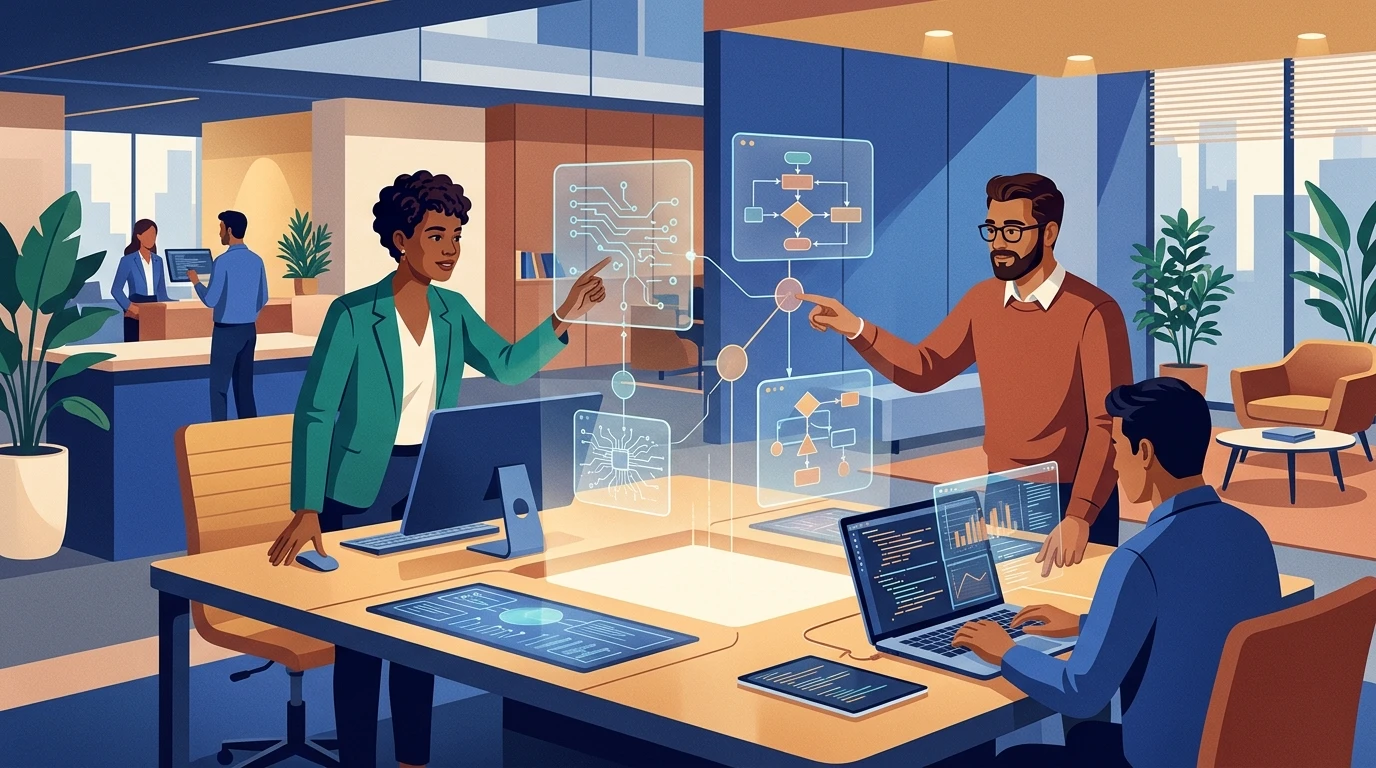
Rather than abandoning artificial intelligence, corporations are restructuring their operational models from outright labor replacement to human-in-the-loop augmentation. Organizations that attempted complete automation are finding that a senior human engineer or domain specialist paired with AI productivity tools can achieve multiples of output, whereas purely automated pipelines accumulate compound errors that require expensive downstream remediation.
Labor economists at prominent business schools characterized the rebound as a classic technological maturation cycle, drawing parallels to early industrial automations and the initial rollout of automated call centers in the late 1990s. Organizations that prioritized short-term quarterly margin expansions by shedding senior human capital discovered that institutional knowledge, cross-departmental coordination, and ethical judgment cannot be synthesized through probabilistic token predictors.
Workforce Realignment and Rising Value of Human Domain Expertise
The rehiring wave has initiated a notable resurgence in compensation for experienced senior specialists who possess deep domain mastery alongside fluency in orchestrating AI agent workflows. Human resources consultancies note that enterprise job postings are increasingly emphasizing critical thinking, systems verification, and ethical risk oversight rather than routine coding or administrative drafting.
As the initial hype cycle transitions into sober enterprise reality, technology executives and venture capitalists acknowledge that artificial intelligence is an extraordinarily powerful cognitive amplifier, not a wholesale replacement for human ingenuity. The companies demonstrating the highest productivity gains moving into 2027 are those investing deliberately in human-machine collaboration, validating the enduring necessity of experienced human expertise in a rapidly automating economy.
Editorial Fact Check & Key Findings
Key points
- Approximately 20% of workers displaced by AI have been rehired.
- Companies report high error rates and customer dissatisfaction from unmonitored AI.
- Demand is rising for human specialists skilled in supervising AI agent pipelines.
What the evidence shows
Labor market studies revealed that companies are reversing full automation initiatives to rehire human domain specialists after encountering algorithmic hallucinations and edge-case failures.
Background and limits
Enterprises are shifting from pure labor replacement to augmented human-in-the-loop workflows.
Why this matters
Documented corporate labor data and employment trends illustrate the practical boundaries of enterprise artificial intelligence adoption.