
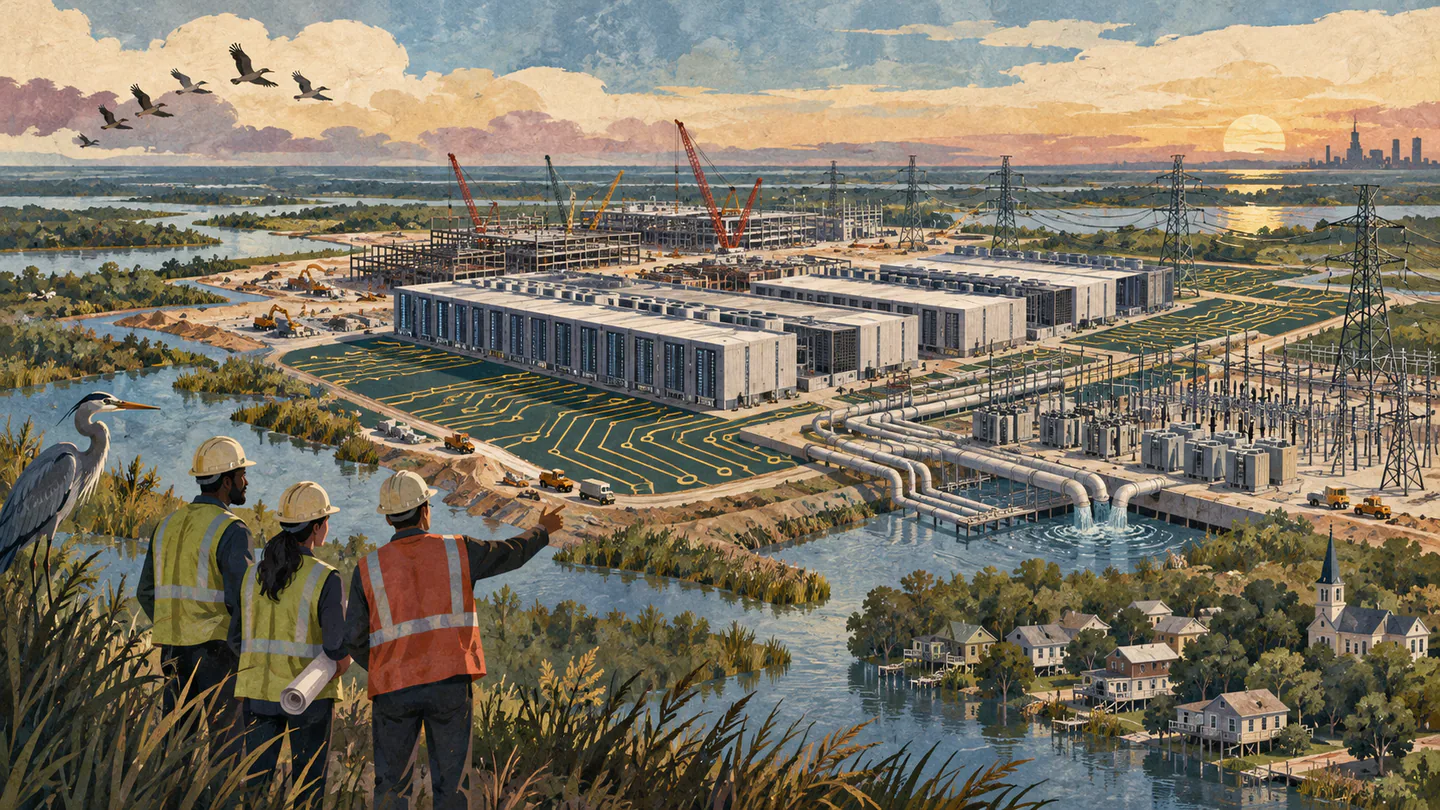
Meta Platforms officially broke ground on the largest artificial intelligence data center in United States history, a colossal $12 billion hyper-scale facility situated on a 2,500-acre campus in northeast Louisiana. The state-of-the-art computational complex is engineered specifically to train and host next-generation multimodal artificial intelligence models, requiring hundreds of thousands of specialized AI accelerator chips and dedicated power infrastructure.
The ground-breaking ceremony was attended by Meta Chief Executive Mark Zuckerberg, Louisiana Governor Jeff Landry, and regional civic leaders. The project is anticipated to generate more than 5,000 direct union construction jobs over a multi-year buildout, along with hundreds of permanent high-wage technical positions in network engineering, systems architecture, and facility operations once energized.
Meeting Colossal Power and Water Demands Through Nuclear and Solar
The monumental computing facility will demand up to two gigawatts of continuous electrical capacity at full buildout, roughly equivalent to the power consumed by a major metropolitan city. To satisfy these staggering energy requirements without derailing corporate net-zero commitments, Meta announced exclusive long-term power purchase agreements with regional utilities, financing the development of new solar installations and small modular nuclear reactors (SMRs).
Water conservation was another primary focal point during project engineering. The facility will employ a next-generation direct-to-chip closed-loop liquid cooling architecture, drastically reducing evaporative water consumption compared to traditional cooling towers. Meta committed to replenishing 100 percent of the water consumed by the facility back into regional watersheds through local ecological restoration programs.
Transforming the Regional Economy into the Silicon Bayou
State and regional economic development officials have hailed the project as a generational catalyst that could transform northern Louisiana into a major national technology corridor, dubbed by boosters as the 'Silicon Bayou.' The presence of Meta’s flagship compute cluster is expected to attract ancillary software firms, advanced fiber infrastructure, and technical training programs at regional universities and community colleges.
However, local community planners and environmental groups have called for strict public oversight regarding electricity rates and transmission grid resilience. State utility regulators have pledged that capital costs for upgrading regional high-voltage transmission lines will be borne directly by corporate developers rather than residential electricity ratepayers.
Editorial Fact Check & Key Findings
Key points
- Initial announcement: December 2024.
- Initial job estimate: 5,000 construction and 500 permanent.
- The project’s announced scope grew substantially by 2026.
What the evidence shows
Meta announced the Louisiana data-center campus in December 2024, initially describing a $10 billion investment, 5,000 temporary construction jobs and 500 permanent operational jobs. By July 2026 the company confirmed an expansion valued around $50 billion.
Background and limits
Meta says it will match electricity use with clean and renewable energy. At the same time, Entergy plans major new gas-fired generation and transmission to serve the campus, prompting debate over ratepayer exposure, tax incentives and emissions.
Why this matters
Investment announcements should separate construction jobs from permanent jobs and corporate renewable-energy matching from the physical generation used to keep a data center operating around the clock.