
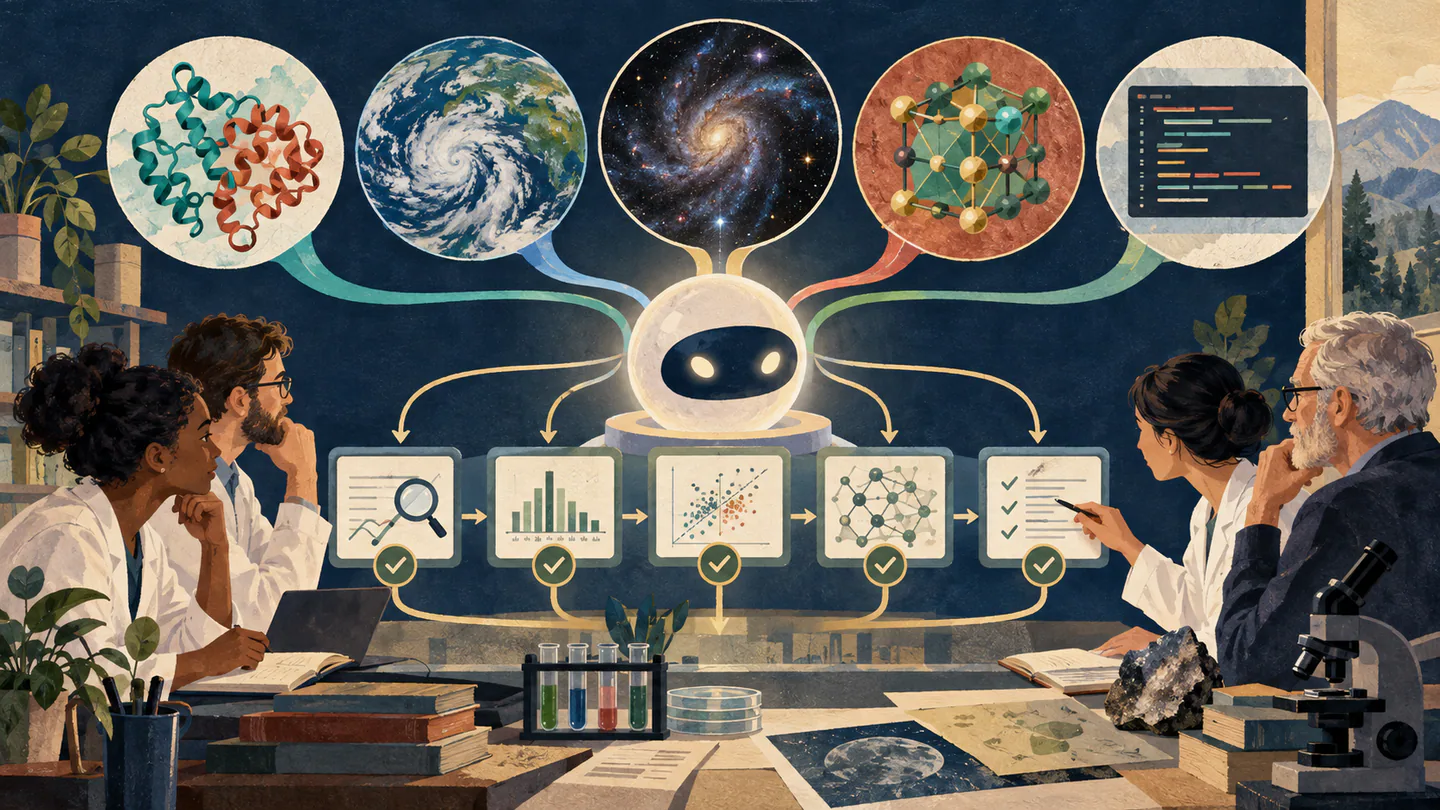
Google officially launched Gemini Ultra 3, its most formidable and sophisticated artificial intelligence model to date, unveiling a groundbreaking suite of autonomous scientific discovery capabilities that researchers believe will fundamentally accelerate breakthroughs in genomics, materials science, and clean energy. The flagship model was unveiled during an international keynote hosted at Google’s headquarters in Mountain View, California.
Unlike conventional large language models trained solely on linguistic tokens, Gemini Ultra 3 was architected from the ground up on unified multimodal scientific datasets, incorporating atomic structural simulations, crystalline chemistry lattices, genomic sequences, and advanced mathematical proofs. The system demonstrated an extraordinary ability to formulate scientific hypotheses, design autonomous laboratory experiments, and accurately predict molecular behavior in simulated environments.
Autonomous Synthesis of Room-Temperature Superconducting Candidates
In a live scientific demonstration that astonished peer scientists, Gemini Ultra 3 successfully analyzed over 200,000 theoretical crystal structures in less than six hours, synthesizing and isolating three previously unknown stable material candidates exhibiting high-temperature magnetic superconductivity characteristics. Independent materials laboratories verified the computational accuracy of the predictions, confirming that the model had independently resolved quantum crystal interactions that had eluded human physicists for decades.
The model also achieved unprecedented benchmarks in biotechnology, generating novel de novo therapeutic proteins engineered to bind specifically to previously 'undruggable' cancer targets. Google announced that it is partnering with leading biomedical research institutes and universities to make these protein candidates freely accessible to oncology researchers worldwide.
Rigorous Safety Protocols and the Era of Autonomous Discovery
Recognizing the profound biosecurity and safety implications of such powerful scientific reasoning systems, Google implemented an unprecedented suite of red-teaming safeguards and biological verification filters. The company collaborated with government national biosecurity agencies and external ethics boards to ensure the model cannot be manipulated to generate dangerous pathogen formulations or toxic chemical compounds.
Technology executives and computer science luminaries worldwide declared the release of Gemini Ultra 3 as the definitive moment artificial intelligence transitioned from a conversational utility to an indispensable collaborator in expanding the frontiers of human scientific knowledge, setting a new global standard for responsible computational innovation.
Editorial Fact Check & Key Findings
Key points
- Google publicly used the Gemini 3.5 and Gemini for Science names.
- Co-Scientist is a research system, not an autonomous laboratory.
- No official “Gemini Ultra 3” launch matched the original article.
What the evidence shows
Google Research described Gemini for Science as a suite of experimental tools for scientific exploration. Its Co-Scientist work helps researchers generate and refine hypotheses, while Gemini 3.5 models added new reasoning and translation capabilities.
Background and limits
These systems can accelerate literature synthesis, coding and candidate generation, but “discovery” still requires expert review, experiments and independent validation. Google’s own case studies are evidence of capability claims, not a substitute for peer review.
Why this matters
Specific model names and evaluation conditions make AI reporting testable. Broad claims of autonomous scientific discovery can outrun what the published evidence shows.