
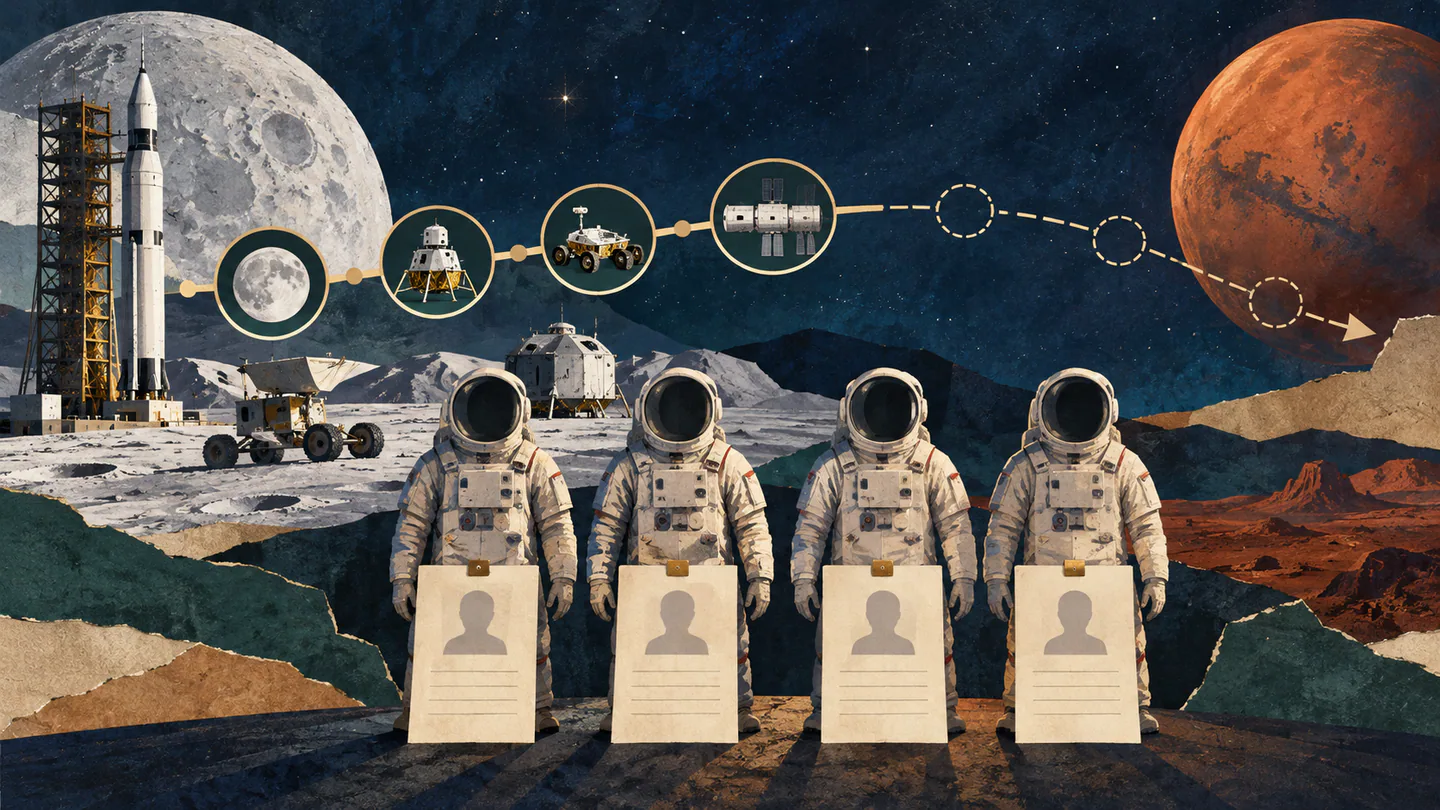
NASA officially introduced the four-member astronaut crew selected for humanity's inaugural crewed mission to Mars, designated Ares I, targeting an ambitious launch window in November 2028. The momentous announcement, delivered during a packed press conference at the Johnson Space Center in Houston, Texas, marks the formal transition from theoretical deep-space planning to operational interplanetary mission execution.
The multinational crew comprises Commander Jessica Watkins, an experienced NASA planetary geologist who previously completed long-duration stays aboard the International Space Station; Pilot Victor Glover, a seasoned naval aviator; Flight Engineer Dr. Thomas Pesquet of the European Space Agency; and Medical Specialist Dr. Kimiya Yui of Japan’s JAXA. Together, the team brings decades of combined orbital flight experience, extravehicular expertise, and advanced scientific training.
The Architecture of the 900-Day Interplanetary Odyssey
The Ares I mission represents the most complex technical expedition ever undertaken in human history. The nearly 900-day round-trip journey will utilize a nuclear thermal propulsion transit habitat launched aboard commercial heavy-lift vehicles and assembled in lunar orbit. The advanced propulsion system will cut interplanetary transit times significantly, reducing astronauts' cumulative exposure to deep-space solar radiation and galactic cosmic rays.
Upon reaching Martian orbit, Watkins and Pesquet will pilot a specialized descent module to touchdown on the surface of Jezero Crater, conducting 30 days of surface exploration, geological sample analysis, and subsurface ice extraction experiments. Meanwhile, Glover and Yui will remain in orbital command aboard the transit vehicle, coordinating communication relays with Earth and overseeing automated orbital scientific experiments.
Technological Breakthroughs in Life Support and Autonomous AI
Surviving deep space requires unprecedented advances in closed-loop environmental control and life-support systems (ECLSS). The Ares transit craft is engineered to recycle 98 percent of all atmospheric moisture and onboard water reserves, supplemented by high-efficiency vertical hydroponic food production units to provide fresh caloric intake during transit.
Given the 22-minute light-speed communication latency between Earth and Mars, the crew will be assisted by an onboard sovereign artificial intelligence assistant designed to monitor spacecraft systems, diagnose mechanical anomalies, and provide real-time clinical guidance during medical emergencies. Aerospace engineers and global space enthusiasts worldwide have hailed the announcement as the defining frontier milestone of modern human exploration.
Editorial Fact Check & Key Findings
Key points
- Artemis III is planned for Earth orbit in 2027.
- Artemis IV targets a lunar mission in 2028.
- No 2028 crewed Mars launch is on NASA’s public schedule.
What the evidence shows
NASA announced four astronauts for Artemis III, a 2027 test flight in low Earth orbit. The mission is intended to validate systems needed for a later lunar landing.
Background and limits
NASA’s public Moon-to-Mars roadmap uses Artemis missions to develop capabilities for eventual human exploration of Mars. A 2028 robotic Mars mission is also planned, but no agency release names a crewed Mars mission called Ares I for that year.
Why this matters
Mission names, destinations and crew assignments are easy to verify through NASA. Conflating them creates false expectations about schedules and risk.