
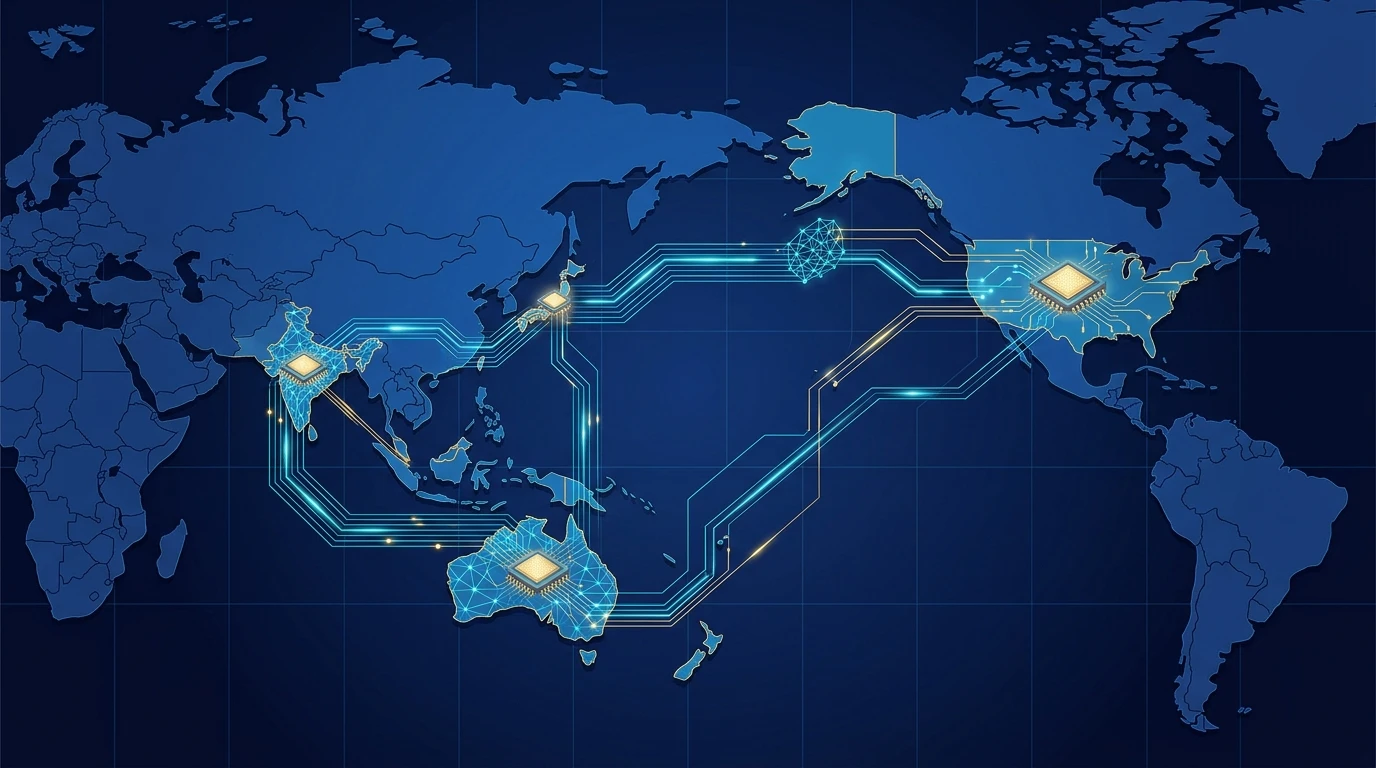
Meeting on the sidelines of international diplomatic talks in Atlanta, senior officials from the United States, India, Japan, and Australia—collectively known as the Quad alliance—announced a landmark $85 million joint funding initiative on Saturday to accelerate the deployment of trusted artificial intelligence infrastructure and secure critical mineral supply chains across the Indo-Pacific region.
Expanding Trusted Artificial Intelligence Infrastructure Across the Indo-Pacific
The flagship component of the agreement establishes a multilateral funding framework to build trusted cloud computing nodes, open-source localized foundation models, and cybersecurity training centers for emerging economies in Southeast Asia and the Pacific Island nations. Led by U.S. Secretary of State Marco Rubio alongside foreign ministers S. Jaishankar of India, Takeshi Iwaya of Japan, and Penny Wong of Australia, the initiative seeks to provide transparent, rule-of-law alternatives to state-subsidized telecommunications and AI platforms.
The joint capital deployment will fund shared access to advanced computing clusters, develop multilingual training datasets tailored to regional languages, and provide technical assistance to ensure national data sovereignty. By subsidizing high-performance computing access, the Quad aims to foster indigenous AI startups and research institutions across partner nations while adhering to rigorous standards of digital privacy, ethical algorithmic transparency, and hardware verification.
Securing Critical Mineral Supply Chains and Countering Economic Coercion
Beyond algorithmic governance, the Quad framework formalizes a binding coordination mechanism for rare earth elements and critical minerals essential to clean energy technologies, advanced semiconductors, and defense manufacturing. The pact establishes joint underwriting standards for mineral processing facilities located in Australia and India, reducing strategic dependencies on concentrated foreign supply chains.
Participating governments agreed to implement a strategic stockpiling protocol and mutual-aid agreements for essential industrial inputs such as lithium, cobalt, neodymium, and dysprosium. The ministers jointly affirmed their commitment to an open, resilient international trading architecture, explicitly rejecting non-market economic practices, predatory state subsidies, and arbitrary export controls designed to leverage resource monopolies for geopolitical advantage.
Semiconductor Fabrication Resilience and Workforce Training
The technical cooperation agreement also incorporates specialized workforce development programs linking academic research hubs across Bangalore, Tokyo, Sydney, and the American semiconductor corridor in Arizona and Ohio. Over 10,000 engineers and technicians will participate in exchange fellowships over the next three years, focusing on packaging technologies, advanced chip fabrication, and secure firmware development.
Industry stakeholders in Silicon Valley and regional technology centers welcomed the announcement, noting that public-private coordination on physical hardware supply lines is essential to safeguarding future artificial intelligence innovation. The Quad working group scheduled its next technical review for early 2027 in New Delhi to monitor deployment milestones and expand private corporate co-investment.
Editorial Fact Check & Key Findings
Key points
- Quad commits $85M in grant and technical assistance funding.
- Pact covers trusted AI computing nodes and critical mineral stockpiling.
- 10,000 semiconductor and engineering fellows to be trained over three years.
What the evidence shows
The Quad nations announced an $85 million financing facility to deploy trusted cloud computing, open localized models, and secure critical mineral supply chains.
Background and limits
Announced alongside ministerial meetings in Atlanta, the initiative establishes shared underwriting for mineral processing in Australia and India.
Why this matters
Multilateral technology agreements shape global computing standards, cybersecurity norms, and physical supply chain resilience.