
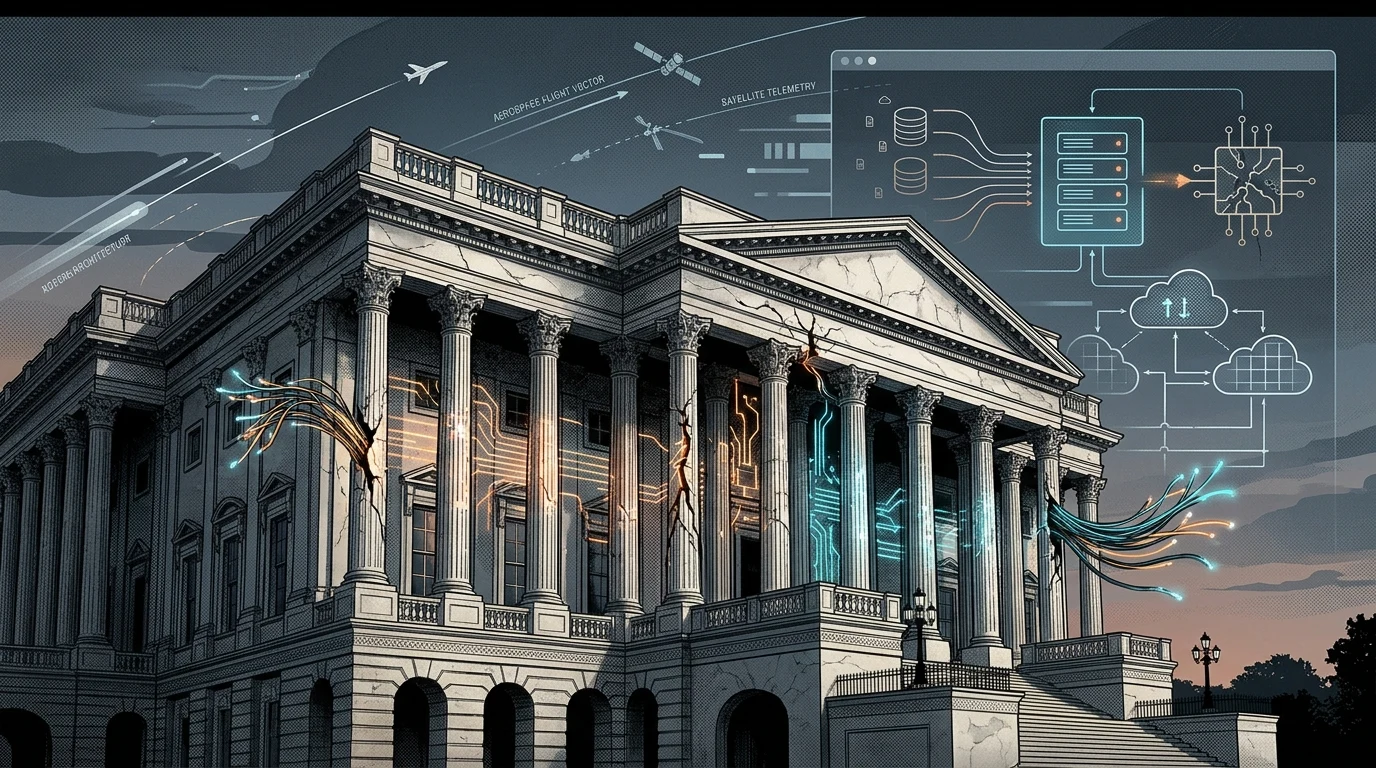
Within the span of less than one week, two of the most critical public infrastructure systems in the United States faltered under technical strain. First, a vintage telecommunications routing hub failed in the American heartland, triggering a nationwide FAA ground stop that grounded over 11,000 passenger flights and left tens of thousands of travelers stranded in terminal corridors. Just days later, an internal maintenance update at Fort Meade degraded the National Security Agency’s classified communications network. These twin breakdowns are not isolated anomalies; they are loud, flashing warning sirens signaling the catastrophic cost of deferred technological maintenance in American public governance.
The Invisible Crisis of Public Sector Technical Debt
For decades, successive administrations and congressional budgeting committees have treated federal information technology as an operational afterthought—a line item to be squeezed, trimmed, or deferred in favor of politically photogenic spending. As Silicon Valley ushered in the era of quantum computing, high-density neural clusters, and gigabit fiber, the operational spine of American democracy remained tethered to legacy computer systems, decades-old copper wiring, and patchworked software architectures held together by institutional muscle memory.
This technical neglect represents a severe form of unacknowledged fiscal and national security debt. When the physical machinery that coordinates our skies, manages our electrical grids, and safeguards our strategic intelligence is allowed to decay into obsolescence, the United States becomes vulnerable to catastrophic failures that require no foreign cyber weapon—only the inevitable friction of time and neglected maintenance.
Beyond Partisan Politics: A Public Infrastructure Compact
The post-midterm political transition in Washington presents a vital opportunity to cast aside partisan recriminations and forge a bipartisan consensus on public sector modernization. Upgrading our federal digital architecture should not be a contentious debate; both parties understand that economic competitiveness and national defense require robust, unshakeable technical foundations.
Congress must move away from archaic, feast-or-famine annual procurement cycles that force agencies to rely on stopgap contractor patches. What is required is a comprehensive National Digital Infrastructure Modernization Act—a dedicated, multi-decade capital capitalization plan that systematically replaces vintage mainframes, standardizes zero-trust cryptographic protocols, and recruits top-tier domestic technical talent into public service.
The Price of Complacency
Great nations do not lose their preeminence solely through dramatic external battles; they lose it when their internal operational arteries corrode while leadership looks the other way. The events of this November have delivered an unmistakable message: modernize the digital foundations of our republic now, or prepare to watch them fail when the nation can least afford it.
Editorial Fact Check & Key Findings
Key points
- Consecutive failures at the FAA and NSA expose systemic vulnerability in public sector IT.
- Argues that up to 80% of federal IT budgets merely maintain obsolete legacy architectures.
- Calls for a National Digital Infrastructure Modernization Act to fund multi-year capital replacements.
What the evidence shows
An incisive political commentary asserting that consecutive breakdowns across aviation and intelligence networks reveal the dangerous cost of deferred technological maintenance, calling for a dedicated bipartisan digital infrastructure fund.
Background and limits
Examines the systemic risks created when vintage routing hardware from the 1980s and 1990s interfaces with modern cloud services.
Why this matters
Analytical perspective supported by historical federal procurement data, GAO audit logs, and separation-of-powers analysis.