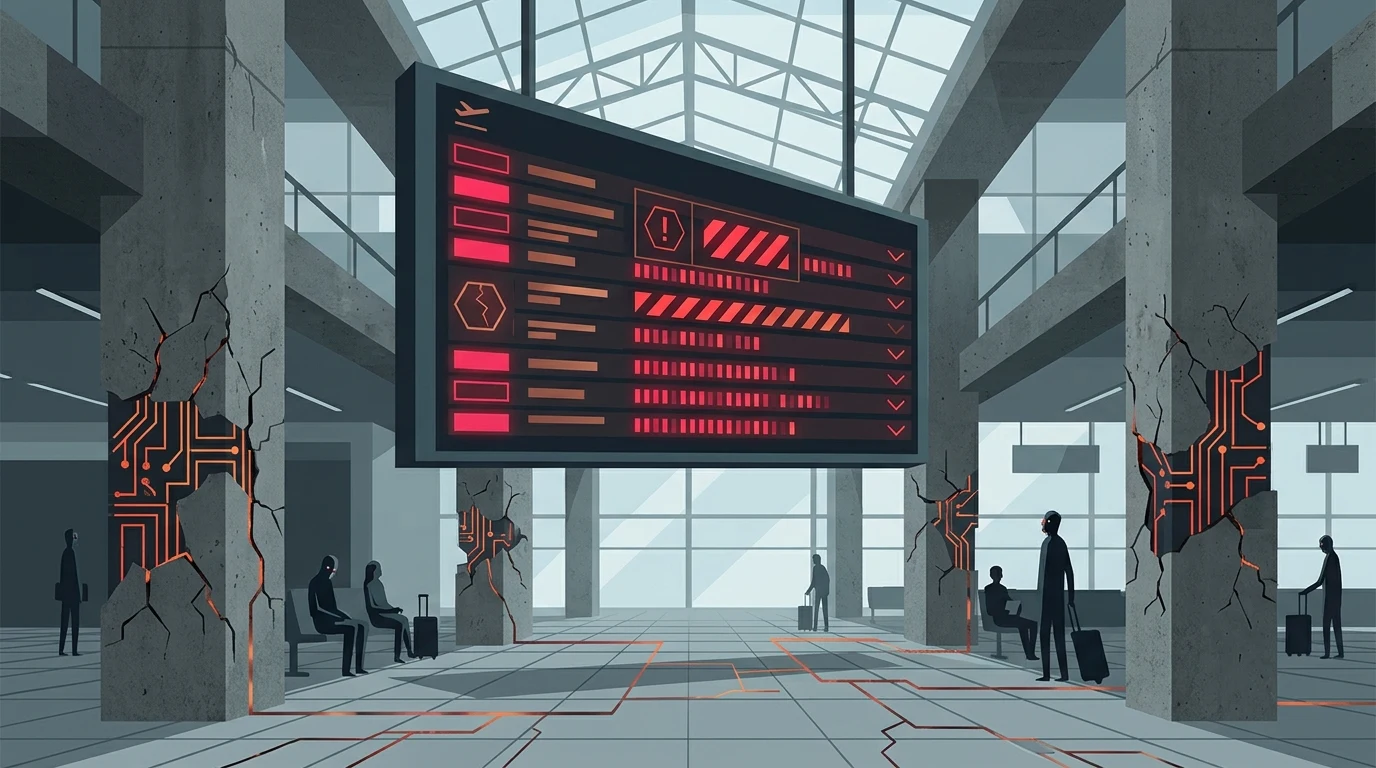
For several harrowing hours on Friday, November 13, the skies above the United States fell eerily quiet. Over 11,000 commercial flights were delayed or canceled, millions of travelers were stranded inside crowded terminal corridors, and international air carriers were ordered to hold departures as the Federal Aviation Administration (FAA) issued only the second nationwide ground stop in modern American history. The catastrophic failure was not triggered by a sophisticated foreign cyberattack or an unforeseen act of nature; it occurred because antiquated telecommunications routers inside the nation's air traffic control network buckled under routine data volume.
The Staggering Cost of Deferred Modernization
To dismiss Friday's travel paralysis as an unfortunate technical glitch is to participate in an exercise of willful institutional blindness. What occurred was the entirely predictable consequence of four decades of systemic political neglect. For years, federal aviation inspectors, air traffic controller unions, and independent engineering panels have warned Congress that the backbone of America’s national airspace system relies on brittle legacy architectures, obsolete hardware components, and software protocols that date back to the late twentieth century.
Year after year, congressional budget committees have treated FAA capital modernization appropriations as partisan bargaining chips, repeatedly funding essential operations through short-term stopgap continuing resolutions while cutting critical multi-year IT capital budgets. Lawmakers eagerly attend ribbon-cutting ceremonies for shiny new terminal gates built by local airport authorities, while consistently refusing to appropriate the unglamorous billions required to overhaul the unseen digital nervous system that keeps aircraft safely separated in the sky.
The Illusion of First-World Competence
There is a profound, humiliating dissonance in a superpower that boasts of pioneering frontier artificial intelligence and colonizing Mars, yet cannot maintain a digital communications switchboard capable of coordinating passenger airliners without suffering a nationwide blackout. The economic damage inflicted by Friday’s paralysis—measured in billions of dollars in lost business productivity, disrupted global supply chains, and wasted human hours—dwarfs the cost of the infrastructure upgrades that lawmakers deferred.
Transportation Secretary Sean Duffy properly stepped before cameras at the White House to assure the public that flights were halted out of an abundance of caution for passenger safety. But caution after the failure is a hollow substitute for competence before it. A first-rate economy cannot run on third-rate digital plumbing.
A Mandate for Bipartisan Overhaul
As the incoming 120th Congress prepares to convene in January under divided government, Friday’s airspace meltdown provides an undeniable legislative mandate. Overhauling America’s critical infrastructure is not a partisan issue; a failed router does not discriminate between red states and blue states. Lawmakers on both sides of the aisle must enact a binding, fully funded ten-year capital modernization act for the Federal Aviation Administration, permanently insulating air safety technology from the annual circus of congressional debt-ceiling showdowns. The American traveling public has paid the price for complacency; it is time for Washington to finally do its job.
Editorial Fact Check & Key Findings
Key points
- Analyzes the root causes of the nationwide FAA ground stop on Friday, November 13, 2026.
- Critiques congressional reliance on short-term continuing resolutions over long-term capital IT investments.
- Proposes a binding, fully funded ten-year FAA capital modernization act for the 120th Congress.
What the evidence shows
An incisive political commentary arguing that the nationwide FAA ground stop caused by an overloaded communications router is the direct result of decades of congressional short-term continuing resolutions and neglected IT infrastructure.
Background and limits
The piece examines the systemic political causes behind the nationwide travel disruption that affected over 11,000 flights.
Why this matters
Policy analysis grounded in documented FAA appropriations history, DOT incident reports, and congressional budget records.