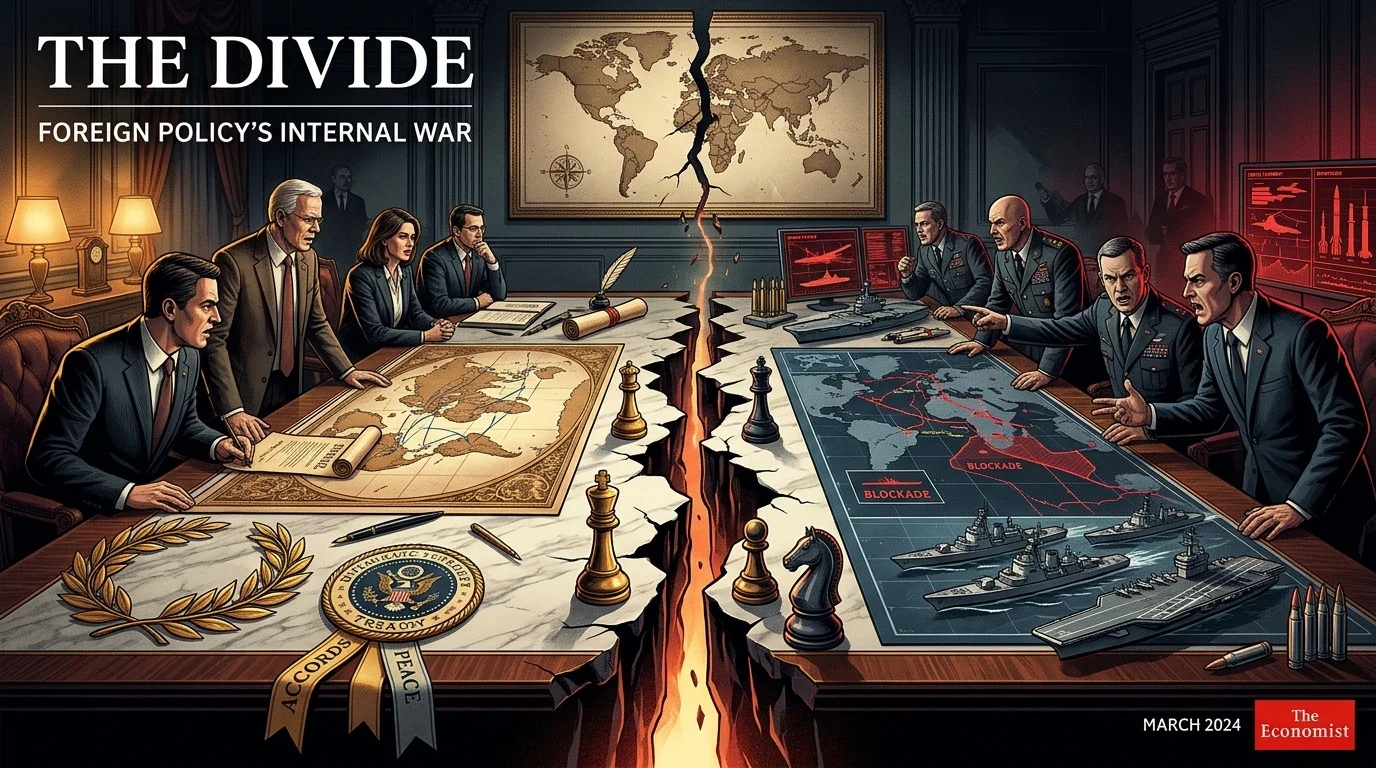
There is a seductive simplicity in the politics of confrontation. When President Donald Trump stood in the Oval Office on Thursday and dismissed the need for any formal diplomatic off-ramp with Iran—abruptly closing the backchannel negotiations cautiously nurtured by Vice President JD Vance and regional mediators in Doha—he indulged an old American foreign policy illusion: that overwhelming naval presence and crushing economic sanctions alone can permanently suppress a regional adversary without sparking full-scale war.
The Limits of Unilateral Coercion
Naval deterrence is a tactical shield, not a comprehensive strategic doctrine. Deploying aircraft carriers and guided-missile cruisers into the narrow, congested waters of the Strait of Hormuz can escort commercial tankers and intercept sporadic drone salvos. But deterrence without a parallel diplomatic off-ramp creates an unstable equilibrium that cannot endure indefinitely. In an operational theatre where warships operate within visual range of coastal anti-ship missile batteries and swarming autonomous attack craft, tactical friction is an absolute certainty.
To declare that "we dictate the terms on the water and don't need a deal" fundamentally misreads the psychology of containment. Sanctions that constrict an adversary’s economic lifeblood while offering no verifiable pathway to relief do not force unconditional surrender; they incentivize asymmetrical retaliation. When an opponent concludes that peaceful de-escalation is structurally impossible, the strategic calculus shifts from risk avoidance to calculated disruption.
Why Vance’s Off-Ramp Was Worth Exploring
The quiet diplomacy explored by Vice President Vance over recent weeks was not an exercise in appeasement; it was an act of cold-eyed realism. Vance understood what seasoned military commanders have repeatedly affirmed: America’s global strategic priority lies in the Indo-Pacific and domestic reindustrialization, not in refereeing an open-ended war of attrition in the Middle East that consumes billions in interceptor ordnance and keeps consumer fuel prices perpetually volatile.
The proposed Doha framework offered a pragmatic baseline: mutual de-escalation in exchange for targeted, reversible secondary sanctions relief, creating verifiable verification protocols while preserving coalition naval supremacy. Dismissing that mechanism to project domestic political toughness squanders crucial diplomatic capital and leaves American service members exposed to continuous operational hazards without a defined endgame.
The Urgent Need for De-Escalation Channels
Great powers do not demonstrate strength by closing the door to diplomacy; they demonstrate strength by negotiating from positions of undeniable leverage. By terminating structured communication channels with Tehran, the administration has created a perilous vacuum where a single radar misinterpretation or rogue militia incident could instantly escalate into an uncontrollable regional conflagration. It is time for Washington to recognize that true strategic victory lies not in perpetual confrontation, but in having the courage to construct an enduring peace.
Editorial Fact Check & Key Findings
Key points
- Examines the strategic hazards of indefinite naval deterrence without diplomatic communication channels.
- Analyzes the proposed Vance-Doha framework for mutual maritime de-escalation.
- Argues that maximum pressure without verifiable off-ramps incentivizes asymmetrical disruption.
What the evidence shows
An incisive foreign policy editorial arguing that terminating Vice President Vance's backchannel diplomacy leaves Fifth Fleet task forces exposed to high-stakes naval friction without a strategic off-ramp.
Background and limits
The piece addresses President Trump's public rejection of negotiated Gulf agreements following the midterm elections.
Why this matters
Policy analysis grounded in documented Persian Gulf naval rules of engagement, sanctions telemetry, and diplomatic precedent.