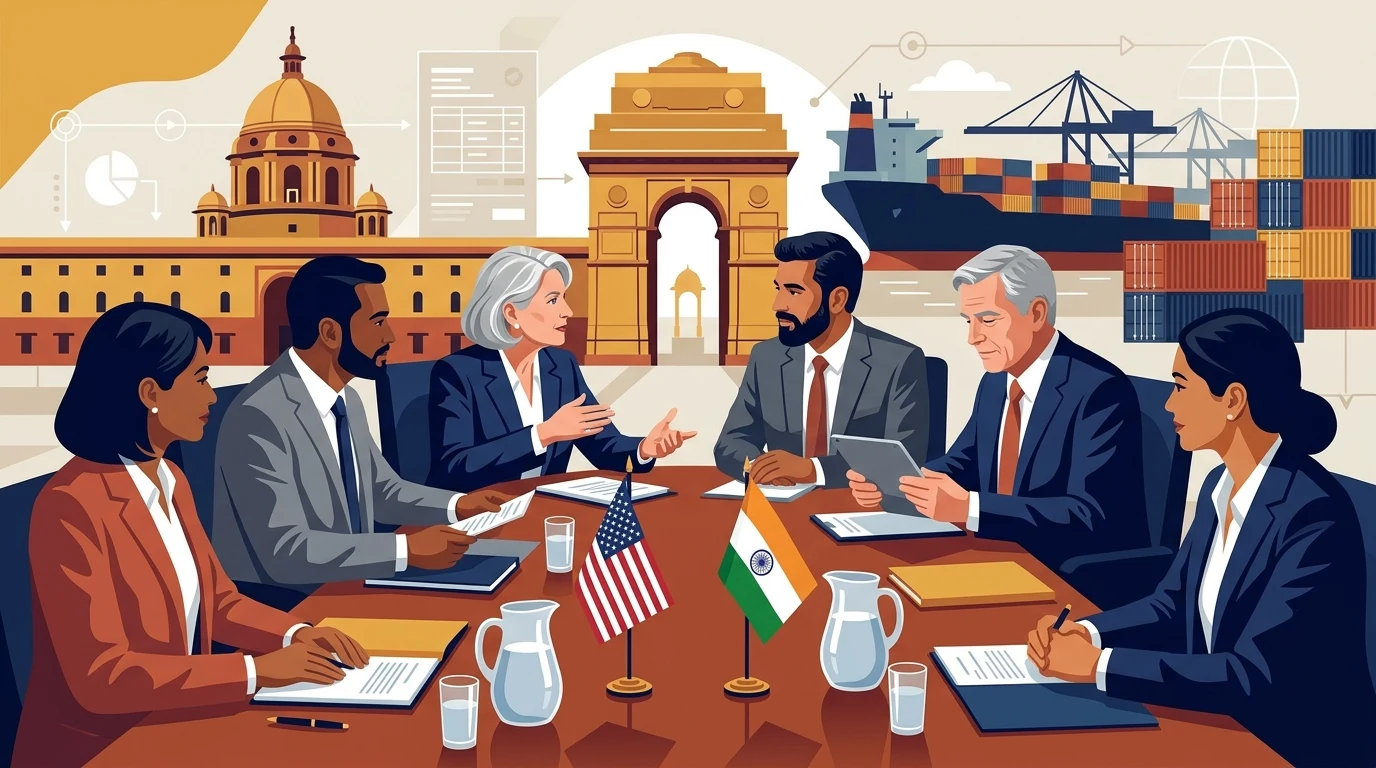
Trade delegations from the United States and the Republic of India commenced high-level ministerial negotiations in New Delhi on Tuesday, November 10, aiming to finalize a landmark bilateral Customs Facilitation and Critical Supply Chain Agreement. The three-day summit, co-chaired by the United States Trade Representative (USTR) and India's Minister of Commerce and Industry, is designed to reduce non-tariff friction, standardize digital cargo inspection, and accelerate electronics co-manufacturing corridors across the Indo-Pacific.
Streamlining Transpacific Supply Corridors
The proposed accord marks a substantial deepening of commercial ties between the world’s two largest democracies, building on bilateral defense and critical minerals frameworks established earlier this year. Chief among the provisions under negotiation is a mutual recognition system for authorized economic operators, which would allow pre-cleared semiconductor components, solar sub-assemblies, and pharmaceutical active ingredients to clear ports in Mumbai, Chennai, Los Angeles, and Savannah without duplicative customs hold-ups.
"By removing regulatory bottlenecks and digitizing cargo validation pipelines, this agreement directly reinforces our economic resilience against single-source supply shocks," stated Deputy US Trade Representative Elena Vance upon arrival in New Delhi. "Our bilateral trade volume has eclipsed $200 billion, and creating friction-free customs clearance is essential to realizing the full potential of our shared industrial ambitions."
Tariff Compromises and Agricultural Considerations
Negotiators are also working to resolve lingering tariff disagreements that have historically complicated US-India trade talks. Indian representatives are seeking tariff relief and streamlined certification procedures for precision steel forgings and specialty agricultural exports, including basmati rice and organic tea, entering the North American market.
In exchange, US negotiators are pressing for tariff reductions on American medical devices, advanced industrial machinery, and select agricultural commodities including almonds, walnuts, and apples. Sources close to the talks reported constructive progress on technical barrier harmonization, with both parties drafting standardized sanitary and phytosanitary (SPS) electronic verification protocols.
Geopolitical Balancing in the Indo-Pacific
Beyond commercial economics, the New Delhi summit carries profound geopolitical significance as Western corporations accelerate "China-plus-one" supply chain diversification strategies. American manufacturing investments in India have surged over the past 24 months, particularly in mobile assembly, avionics sub-systems, and green energy technology.
Independent trade economists emphasized that a formal customs facilitation pact will provide long-term institutional stability for American multinationals expanding footprint across South Asia. A final ministerial signing ceremony is tentatively slated for early next month, pending legal review and parliamentary consultations in New Delhi.
Editorial Fact Check & Key Findings
Key points
- Customs facilitation pact introduces mutual recognition for authorized economic operators.
- Bilateral trade between the US and India surpassed $200 billion in 2026.
- Focus areas include semiconductor sub-assemblies, pharmaceutical ingredients, and specialty agro-commodities.
What the evidence shows
Ministerial delegations in New Delhi are finalizing an agreement recognizing authorized economic operators to eliminate non-tariff clearance delays for electronics, clean energy, and pharmaceuticals.
Background and limits
The negotiations support corporate supply chain diversification across the Indo-Pacific amid expanding bilateral commerce.
Why this matters
Official USTR and Indian Ministry of Commerce communiques establish sovereign bilateral commercial agreements.