
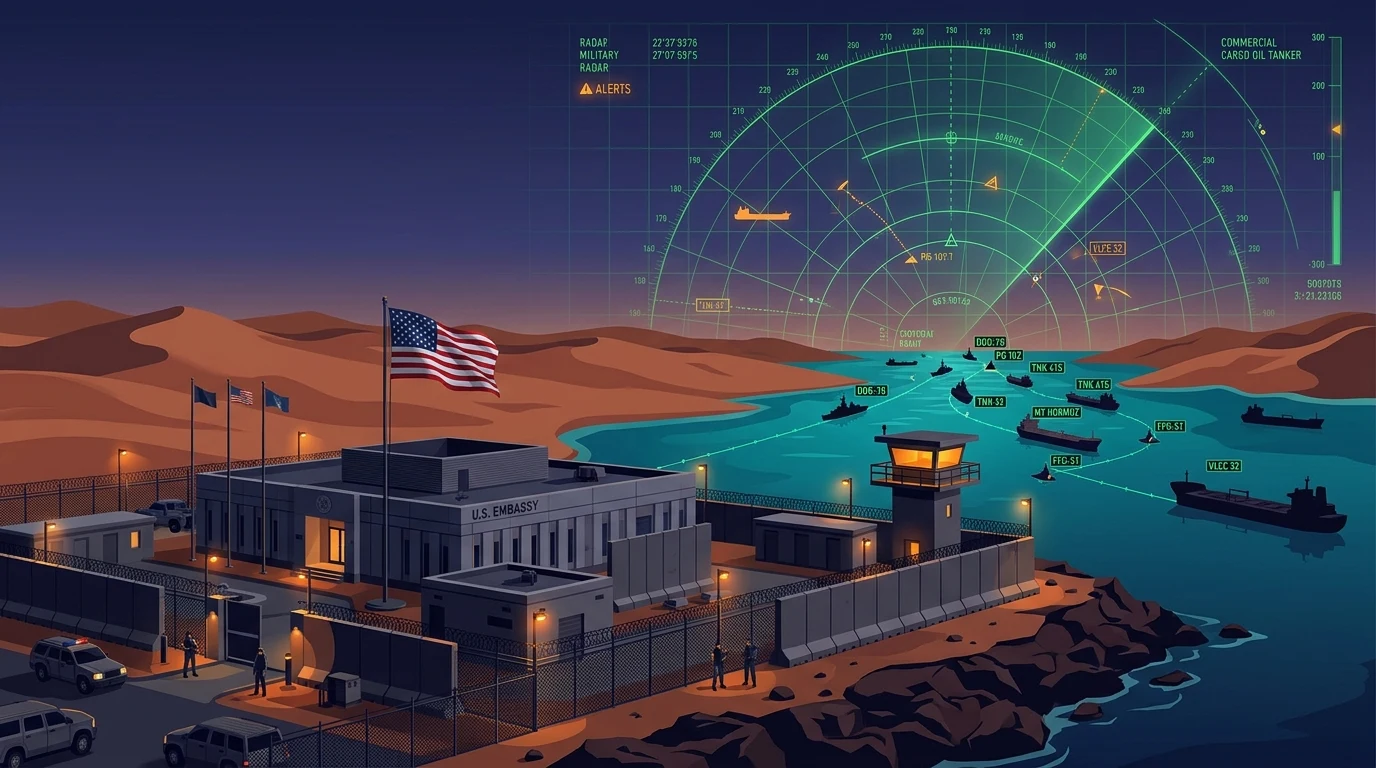
Heightened geopolitical tensions in the Middle East prompted the United States Department of State and regional diplomatic missions to issue high-level security alerts across the Persian Gulf on Wednesday, November 18. American embassies in Kuwait, Bahrain, and the United Arab Emirates advised U.S. citizens to maintain heightened vigilance, avoid non-essential travel near military installations, and review personal emergency evacuation plans following precision American military strikes targeting coastal missile batteries and drone launch facilities threatening maritime commerce near the Strait of Hormuz.
Targeted Strikes on Maritime Threat Nodes
According to Department of Defense and U.S. Central Command (CENTCOM) operational briefings, the overnight airstrikes were launched in direct response to repeated anti-ship ballistic missile tracking maneuvers and unmanned aerial vehicle incursions directed at commercial oil tankers navigating international transit lanes. Carrier-based strike aircraft and guided-missile destroyers operating in the northern Arabian Sea launched precision-guided munitions against radar command installations, coastal missile bunkers, and mobile launcher convoys.
"The United States will not permit hostile regional forces to threaten international freedom of navigation or hold the global energy supply hostage to reckless aggression," a senior defense official stated during a Pentagon briefing. "Our military actions were focused, proportional, and engineered strictly to degrade hostile anti-ship missile capabilities that directly endangered commercial merchant crews and naval escort vessels operating in lawful international waters."
Regional Diplomatic Precautions and Embassy Advisories
In response to potential asymmetric retaliation, U.S. diplomatic missions across the Gulf enacted enhanced security postures, restricting official personnel travel and advising private American expatriates and maritime logistics workers to monitor local news broadcasts and register with the Smart Traveler Enrollment Program (STEP). Regional commercial air carriers also adjusted flight corridors away from coastal air-defense sectors as a precautionary safeguard.
Diplomatic delegations from Gulf Cooperation Council (GCC) partner nations convened emergency consultations in Riyadh, calling for de-escalation while affirming that the protection of critical energy export terminals and shipping corridors remains paramount for regional and international economic stability.
Energy Market and International Shipping Vigilance
Maritime security alliances including the International Maritime Security Construct (IMSC) increased armed warship patrols throughout the Strait of Hormuz, through which roughly 20% of global petroleum consumption passes daily. Marine insurance underwriters in London raised war-risk premiums for commercial tankers operating in the region, prompting shipowners to maintain maximum operational speed and implement electronic warfare counter-surveillance protocols.
Editorial Fact Check & Key Findings
Key points
- U.S. embassies in Kuwait, Bahrain, and UAE issued emergency travel and security alerts.
- CENTCOM conducted precision strikes against hostile coastal missile sites threatening tankers.
- International maritime security coalitions bolstered warship patrols throughout the Strait of Hormuz.
What the evidence shows
The U.S. State Department and regional embassies in the Persian Gulf issued urgent security advisories following targeted American military strikes against coastal missile launch sites threatening commercial shipping in the Strait of Hormuz.
Background and limits
Precision strikes targeted anti-ship missile radar installations after commercial tankers were threatened.
Why this matters
Official U.S. Embassy emergency notices and CENTCOM operational press statements verify events.