
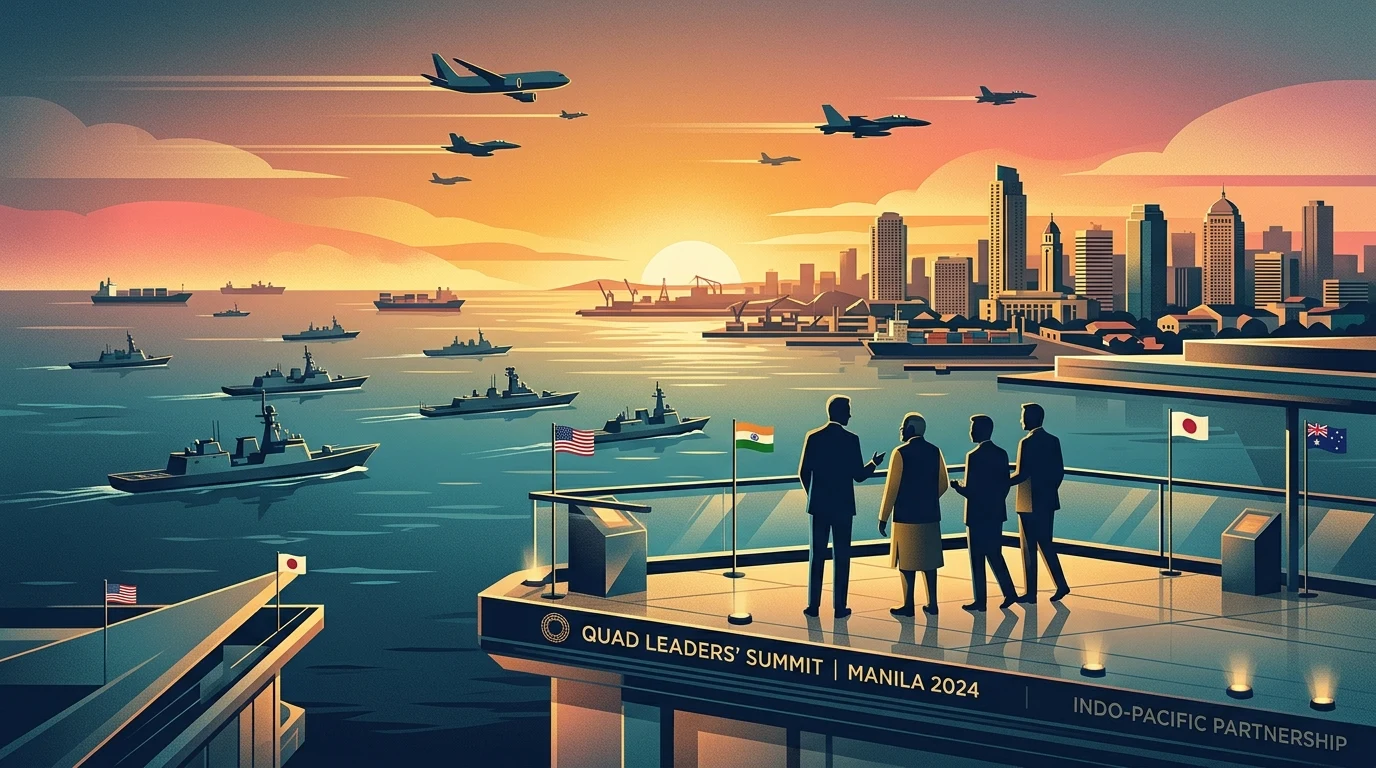
The leaders of the Quadrilateral Security Dialogue—comprising the United States, India, Japan, and Australia—concluded a historic two-day summit in Manila, Philippines, on Tuesday, November 17, issuing a comprehensive joint communique that significantly broadens their collective defense and economic integration across the Indo-Pacific region. Facing persistent maritime tensions and shipping route vulnerabilities, the Quad partners agreed to formalize joint coast guard patrols, expand interoperable naval exercises, and establish reciprocal critical mineral supply corridors.
Strengthening Maritime Domain Awareness
The Manila summit marked the first in-person gathering of the four leaders following the American midterm elections, sending an unambiguous diplomatic signal that bipartisan U.S. commitment to Indo-Pacific deterrence remains steadfast. Central to the newly unveiled agreements is the expansion of the Indo-Pacific Partnership for Maritime Domain Awareness (IPMDA), which integrates commercial satellite imagery and autonomous surveillance craft to assist Southeast Asian partner nations in monitoring illegal fishing, unauthorized maritime incursions, and dark vessel tracking.
"Our gathering in Manila reaffirms that a free, open, prosperous, and secure Indo-Pacific is indispensable to global peace and economic stability," the leaders declared in their unanimous joint statement. "We stand resolute in upholding international maritime law, freedom of navigation, and the peaceful resolution of disputes without coercion. Through expanded maritime coordination and institutional partnership, we are ensuring that the shared oceans of the world remain governed by law rather than force."
Reciprocal Trade and Critical Mineral Alliances
Beyond defense deterrence, the summit produced tangible economic agreements designed to reduce industrial dependence on single-source supply chains for critical minerals, rare earths, and clean energy components. Alongside the multilateral Quad meetings, American and Thai trade delegations signed a bilateral reciprocal trade and technology pact, establishing accelerated investment frameworks for high-tech semiconductor packaging facilities in Southeast Asia.
The four nations also finalized a landmark Critical Minerals Security Accord, establishing a joint financing mechanism to develop rare earth processing facilities in Australia and India. By co-funding mineral extraction and refining projects, the Quad aims to ensure an uninterrupted supply of lithium, neodymium, and gallium required for domestic defense hardware and electric vehicle manufacturing.
Regional Diplomatic Reception
Philippine President Ferdinand Marcos Jr., who hosted the summit delegations at Malacañang Palace, praised the Quad’s constructive engagement with ASEAN member states, emphasizing that multilateral partnerships bolster regional sovereignty and economic resilience. Diplomatic observers noted that the Manila declarations successfully transition the Quad from a consultative security forum into a functional economic and defense alliance capable of delivering tangible public goods to the entire Indo-Pacific theater.
Editorial Fact Check & Key Findings
Key points
- Leaders of the US, India, Japan, and Australia finalized new joint maritime patrols and training.
- Expanded Indo-Pacific Partnership for Maritime Domain Awareness (IPMDA) satellite tracking.
- Signed Critical Minerals Security Accord and bilateral US-Thailand trade agreement.
What the evidence shows
The Quad Leaders' Summit in Manila concluded on Tuesday with landmark agreements expanding multilateral coast guard patrols, maritime domain awareness satellite sharing, and critical mineral supply security alliances.
Background and limits
The summit reinforced allied commitment to a free and open Indo-Pacific and freedom of navigation across the South China Sea.
Why this matters
Official White House, State Department, and Malacañang Palace summit joint communiques verify agreements.