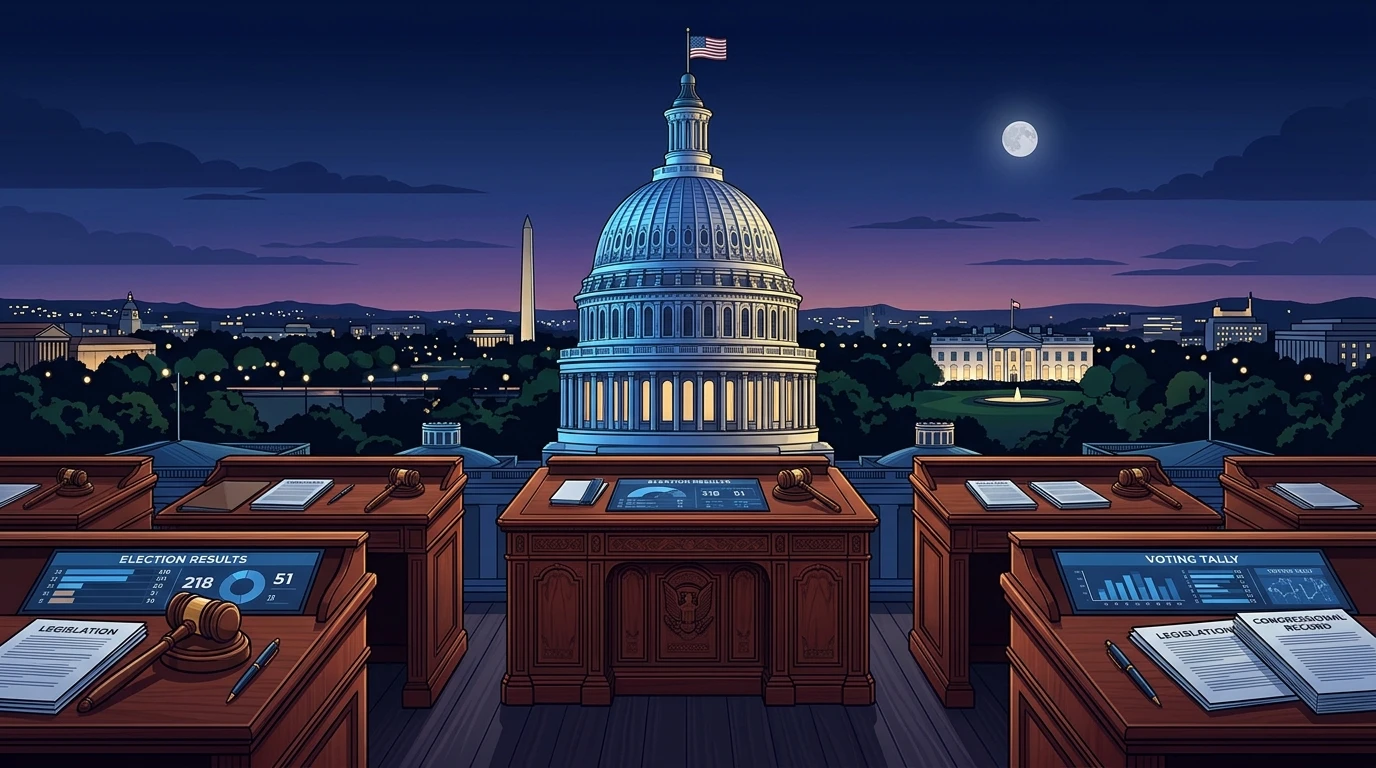
In a historic midterm realignment that reshapes the balance of American political power, the Democratic Party has captured majorities in both the United States House of Representatives and the United States Senate following the finalization of key battleground tabulations over the weekend. Propelled by widespread voter anxiety over persistent living costs, elevated grocery prices, and compounding geopolitical tensions, the sweeping "blue wave" brings an abrupt end to two years of unified Republican governance in Washington.
Decisive Flips Across Suburban and Sun Belt Battlegrounds
Decision desks and state election directors confirmed crucial seat flips across key congressional districts in New York, California, Pennsylvania, Arizona, and Virginia. In the House, Democrats surpassed the 218-seat threshold after decisive suburban gains in districts previously carried by conservative incumbents in 2024. House Democratic Leader Hakeem Jeffries, preparing to assume the Speaker’s gavel in January, declared the outcome an unmistakable mandate for economic relief, accountability, and the restoration of robust institutional checks and balances.
In the Senate, high-profile Democratic victories in critical contests—including closely fought races in Ohio, Pennsylvania, Wisconsin, and Montana—flipped the chamber to Democratic control with a working 51-49 majority. Exit polling and nonpartisan voter analyses conducted by the Associated Press and regional universities revealed that independent voters, who broke decisively away from the governing coalition, cited cumulative inflation, rising auto insurance premiums, and unpredictable tariff disputes as their foremost voting considerations.
Presidential Reaction and the Reality of Divided Government
Addressing the election results publicly on Sunday, President Donald Trump characterized the midterm losses as an unfortunate setback for his administration’s agenda, attributing market volatility and electoral headwinds to external geopolitical disruptions and rising energy costs tied to the Middle East conflict. The President vowed that his movement would reorganize rapidly ahead of the 2028 presidential campaign, while signaling an aggressive posture toward incoming congressional oversight.
The transition to divided government fundamentally freezes the White House’s domestic legislative agenda. Sweeping plans for federal deregulation, national energy subsidies, and conservative judicial fast-tracking now face an impenetrable legislative wall on Capitol Hill. Instead, incoming committee chairs are already assembling extensive investigative agendas focused on federal agency spending, trade policy decisions, and regulatory enforcement across health and environmental portfolios.
Legislative Priorities and Budgetary Showdowns for 2027
Democratic leaders moving into the 120th Congress have outlined an aggressive initial legislative slate centered on consumer protection, capping essential drug costs, safeguarding public education funding, and introducing comprehensive anti-price-gouging statutes. However, with the presidential veto pen firmly in place, analysts anticipate fierce budgetary confrontations, particularly surrounding upcoming statutory debt ceiling deadlines and annual federal appropriations.
Constitutional scholars and policy strategists note that the midterm results reflect an electorate deeply resistant to unilateral governance. While the President will likely pivot toward executive orders and diplomatic maneuvers where executive authority is broad, domestic governance will require rare bipartisan accommodation if basic federal funding and infrastructure operations are to proceed without prolonged institutional gridlock.
Editorial Fact Check & Key Findings
Key points
- Democrats secured working majorities in both the House and Senate.
- Suburban and independent voters broke decisively against the governing coalition.
- Control flips the legislative agenda toward oversight and consumer price investigations.
What the evidence shows
Decision desks confirmed that Democrats captured majorities in both the US House and Senate following battleground tabulations in New York, California, Pennsylvania, and Arizona.
Background and limits
The election establishes divided government, halting the administration’s domestic legislative agenda and empowering incoming committee chairs.
Why this matters
Certified ballot counts and race calls provide essential documentation of constitutional governance and legislative power shifts.