
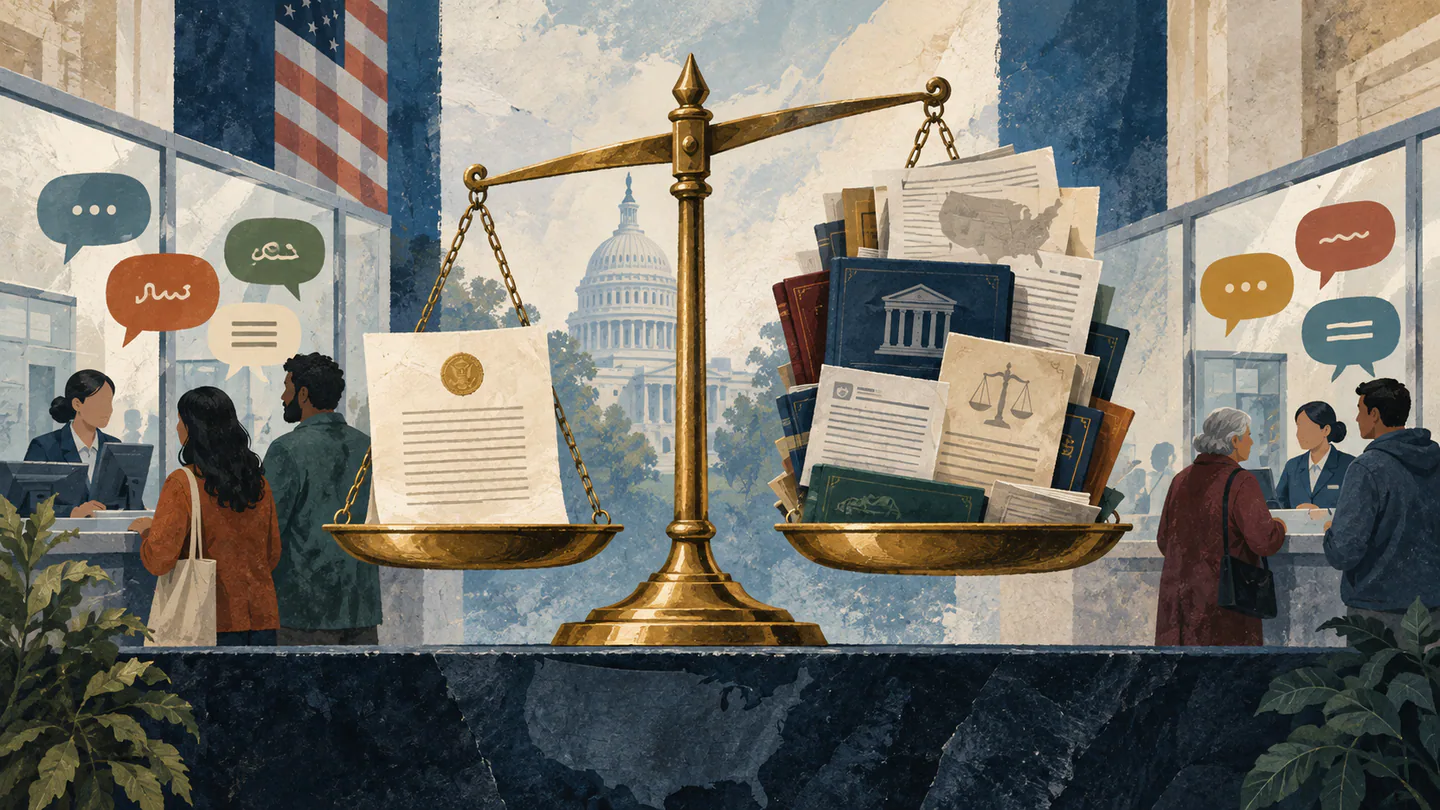
President Donald Trump signed an executive order designating English as the official language of the United States federal government, directing all executive departments and federal agencies to conduct official business, documentation, public notices, and administrative hearings primarily in English. The proclamation revokes prior executive mandates that required extensive multilingual service provisions across federal grant programs and agency communications.
The signing ceremony at the Oval Office included conservative lawmakers, civic advocacy groups, and state officials who have long championed English language designations at the state level. Supporters framed the measure as an essential instrument for promoting national cohesion, reducing administrative translation expenditures, and encouraging immigrant assimilation into the civic fabric of the country.
Sharp Legal Challenges and Civil Rights Pushback
The executive action was immediately met with forceful condemnation from civil rights organizations, immigrant advocacy coalitions, and several state attorneys general, who announced emergency lawsuits challenging the order's constitutional validity. Legal scholars noted that the United States has historically never possessed an official federal language, reflecting its founding philosophy of decentralized governance and multicultural roots.
Opponents argue that restricting federal translation services violates Title VI of the Civil Rights Act of 1964, which prohibits discrimination based on national origin in federally funded programs. Advocacy groups warned that curtailing non-English notices could prevent millions of tax-paying legal residents with limited English proficiency from accessing critical emergency alerts, disaster relief assistance, veterans benefits, and healthcare information.
Impact on Federal Operations and State Sovereignty
The directive allows narrow exceptions for national security matters, international diplomatic relations, public health emergencies, and law enforcement investigations. However, federal agency administrators privately acknowledged that retrofitting digital portals, customer support hotlines, and informational pamphlets will create substantial operational confusion and potential service delays.
More than 30 states already have various statutory provisions recognizing English as their official language, though implementation varies widely across jurisdictions. Legal experts expect the executive order to face swift injunctions in federal appellate courts, setting up a contentious constitutional showdown over the scope of presidential authority over federal administrative communication.
Editorial Fact Check & Key Findings
Key points
- The order was signed on 1 March 2025.
- It gives agencies discretion over language services.
- No blanket 180-day phaseout appears in the order.
What the evidence shows
Executive Order 14224, signed on 1 March 2025, designated English as the official language of the United States and revoked a prior order on language access.
Background and limits
The order allowed agency heads to decide how to provide services in languages other than English. Later Justice Department guidance encouraged agencies to reduce nonessential multilingual services, but the order did not impose the uniform 180-day phaseout previously claimed.
Why this matters
Readers affected by language access need the operative text, not an exaggerated deadline. Statutes and program-specific obligations may still require translation or interpretation.