
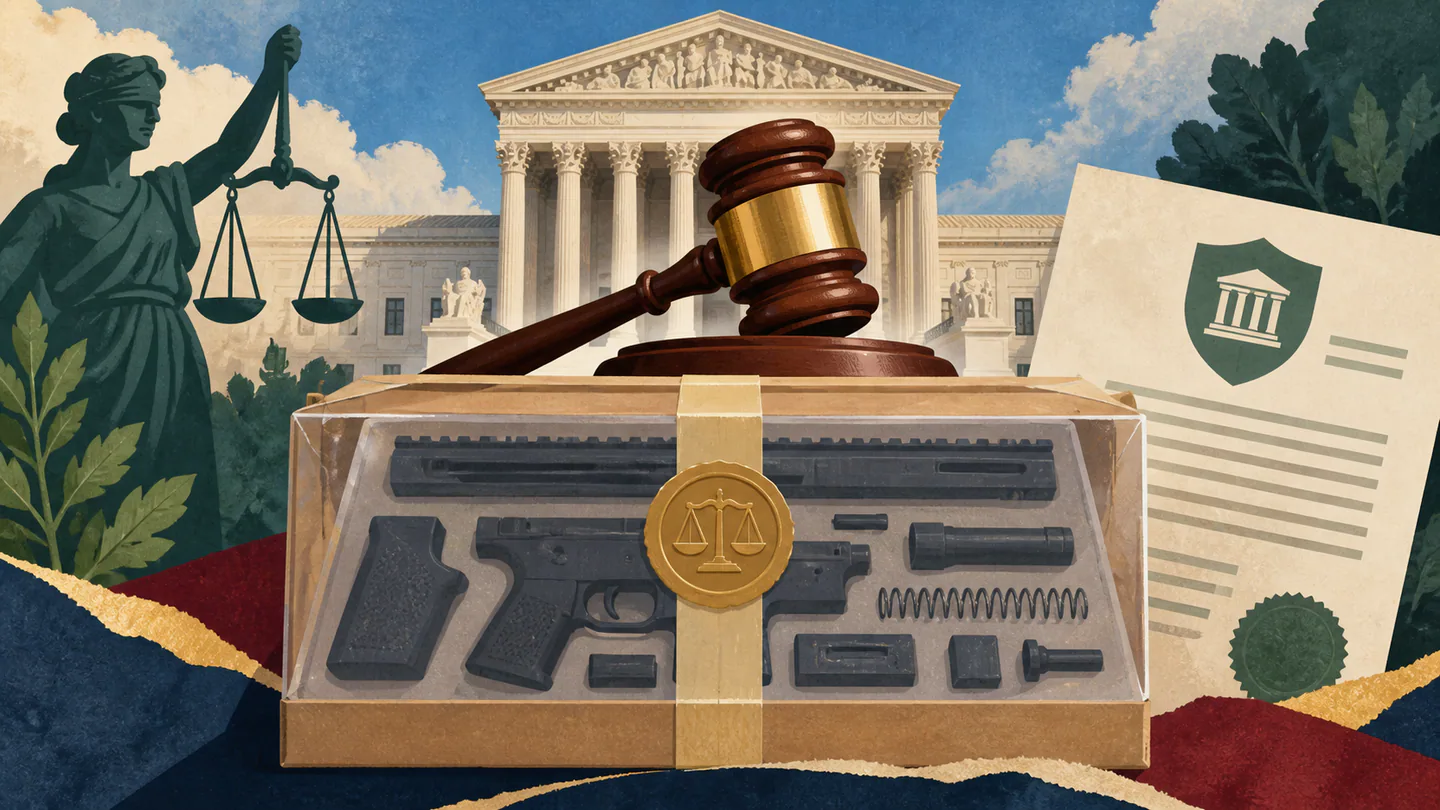
The Supreme Court of the United States issued a definitive 6-3 ruling upholding federal regulations on 'ghost guns'—untraceable, unserialized firearms assembled from privately purchased kits or produced via 3D printing technologies. The landmark decision confirms the statutory authority of the Bureau of Alcohol, Tobacco, Firearms and Explosives (ATF) to classify firearm parts kits as firearms under the Gun Control Act of 1968, requiring manufacturers to stamp serial numbers and dealers to conduct mandatory criminal background checks prior to sale.
Chief Justice John Roberts authored the majority opinion, joined by the court’s three liberal justices along with Justices Brett Kavanaugh and Amy Coney Barrett. The majority determined that parts kits designed to be readily converted into functional lethal weapons fall squarely within the statutory definition of a firearm established by Congress, rejecting arguments from gun-rights advocacy groups that component parts cannot be regulated until fully assembled.
A Major Victory for Law Enforcement and Gun Safety Advocates
The ruling represents a monumental legal victory for the Department of Justice, municipal mayors, and major law enforcement associations across the country. In recent years, police departments in major metropolitan areas reported staggering spikes in the recovery of untraceable ghost guns from violent crime scenes, homicide investigations, and illicit trafficking networks.
Gun safety organizations celebrated the decision, emphasizing that closing the ghost gun loophole prevents convicted felons, domestic abusers, and minors from circumventing federal background checks simply by purchasing build-at-home kits online without identification. Police chiefs highlighted that serial numbers are vital tools for tracing crime guns back to their original point of sale and dismantling criminal enterprises.
Dissenting Opinions and Future Second Amendment Litigation
Justice Clarence Thomas authored a vigorous dissent, joined by Justices Samuel Alito and Neil Gorsuch. The dissenting opinion argued that the ATF had exceeded its administrative authority by effectively rewriting federal statutes without explicit authorization from Congress, asserting that unfinished metal or polymer receivers do not meet the historical legal definition of a completed firearm.
Second Amendment advocacy groups expressed sharp disappointment with the outcome, warning that administrative agencies could use the ruling as a precedent to expand regulatory restrictions over other firearm accessories and hobbyist machining tools. While the decision settles the immediate regulatory status of ghost gun kits under federal law, legal scholars anticipate ongoing constitutional litigation over state-level firearm restrictions in lower federal courts.
Editorial Fact Check & Key Findings
Key points
- Decision date: 26 March 2025.
- Vote: 7-2.
- The case concerned statutory authority, not a universal ban.
What the evidence shows
On 26 March 2025 the Supreme Court ruled 7-2 that the Gun Control Act permits the Bureau of Alcohol, Tobacco, Firearms and Explosives to regulate some ghost-gun kits and unfinished frames or receivers.
Background and limits
The ruling addressed whether the agency’s rule fit the federal statute. It did not resolve a broad Second Amendment challenge, and it did not create a new congressional “ban” on all homemade firearms.
Why this matters
Calling the rule a blanket ban hides what buyers and sellers must actually do: covered commercial kits are subject to licensing, serial-number, recordkeeping and background-check requirements.