OPINION — For the past three decades, Silicon Valley operated under an unspoken, almost religious assumption of digital immateriality. Software was celebrated because it was weightless, friction-free, and infinitely scalable across cloud servers hidden beyond the horizon. Yet as artificial intelligence transitions from conversational novelties to planetary-scale reasoning engines, tech titans are colliding violently with the stubborn, immovable realities of classical physics.
The defining contest for technological and geopolitical hegemony between the United States and strategic adversaries over the next quarter-century will not be decided solely in algorithm research labs or semiconductor cleanrooms. It will be decided at the electrical substation, the high-voltage transmission corridor, and the nuclear reactor core.
The Gigawatt Chokepoint
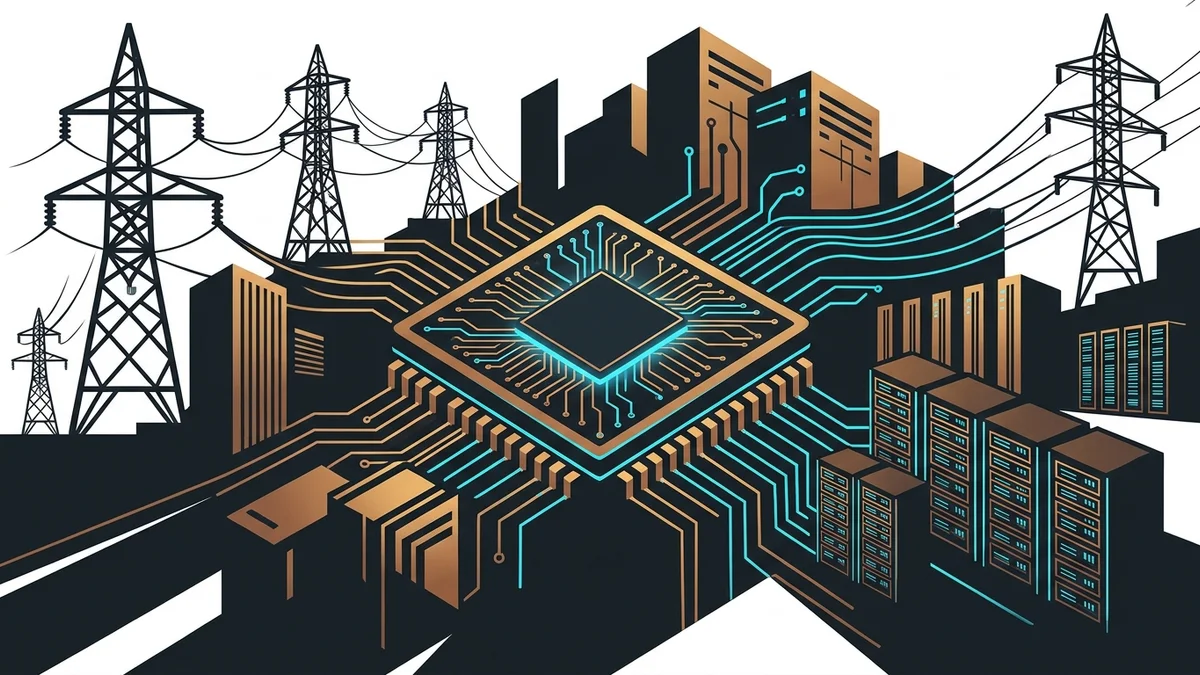
Modern frontier AI clusters are no longer standard computer server rooms; they are voracious energy hydras. A single next-generation hyperscale data center campus currently under design requires between one and two gigawatts of continuous electric capacity—an energy appetite equivalent to powering a metropolitan city of 1.5 million households.
Compute without electrons is merely inert sand. While American venture capital has poured hundreds of billions of dollars into AI foundation models and specialized accelerators, our physical infrastructure is running headfirst into a catastrophic capacity chokepoint:
“You can train the most brilliant neural network on paper, but if you cannot procure 1.5 gigawatts of uninterrupted, carbon-free power to illuminate its GPUs, your technological advantage evaporates. The hard truth facing Washington is that software dominance is nothing without energy sovereignty.”
In major data center hubs like Northern Virginia’s Data Center Alley, regional utilities have warned that interconnection queues now stretch past 2030. Tech companies seeking to connect massive new facilities are encountering waiting lists measured in seven-to-ten-year horizons, hamstrung by archaic state permitting, litigious local zoning, and an interstate transmission grid engineered in the Eisenhower era.
The Strategic Realignment Toward Nuclear Baseload
It is this existential energy constraint that explains the sudden, feverish corporate rush toward nuclear recommissioning. When Microsoft underwrites the revival of Three Mile Island and Google signs purchase agreements for small modular reactors, it is not merely corporate virtue-signaling on carbon reduction. It is a desperate recognition that intermittent solar and wind, even paired with chemical battery storage, cannot deliver the unbroken 99.999% uptime required by delicate semiconductor clusters.
Meanwhile, geopolitical rivals like China are executing a disciplined, state-directed infrastructure blitz, constructing dozens of gigawatt-scale nuclear reactors, massive ultra-high-voltage (UHV) direct-current transmission superhighways, and centralized hydro-storage complexes specifically designed to power domestic computing hubs.
A Call for Permitting Patriotism
If the United States intends to maintain its leadership in artificial intelligence and economic competitiveness, federal policymakers must treat power generation and transmission with the same urgency mobilized during wartime industrial production.
We need radical permitting reform that cuts through multi-year bureaucratic environmental review loops for clean interstate power corridors. We must fast-track standardized regulatory licensing for small modular reactors and invest aggressively in advanced grid technologies like dynamic line rating and high-temperature superconductors.
The digital frontier has arrived at a physical crossroads. Software has conquered the world; now, America must build the energy foundations to keep the lights on.