
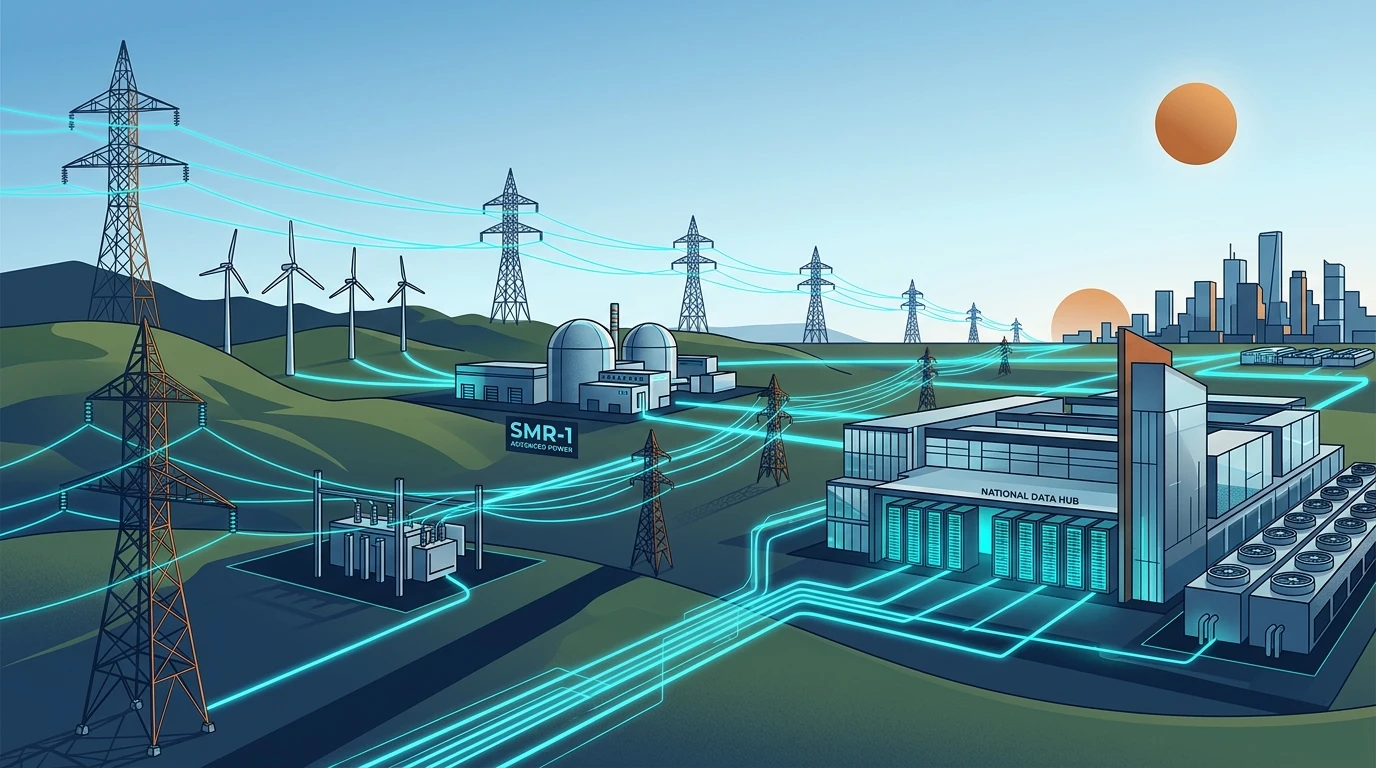
In its first major legislative breakthrough following the midterm elections, the United States Senate voted by an overwhelming bipartisan margin of 68-29 on Monday, November 9, to advance the American Energy Infrastructure and Grid Modernization Act of 2026. The landmark legislative package is designed to fundamentally overhaul federal permitting statutes, expedite regional high-voltage transmission lines, and accelerate commercial licensing for advanced small modular nuclear reactors (SMRs) to meet surging electrical demand from artificial intelligence data centers and domestic manufacturing.
Overcoming the Federal Permitting Bottleneck
The legislation represents the most ambitious federal reform of energy infrastructure permitting in more than three decades. For years, regional transmission lines connecting remote clean energy generation with urban and computational demand hubs have languished in federal environmental reviews averaging seven to ten years under the National Environmental Policy Act (NEPA). The Senate bill establishes strict two-year statutory deadlines for environmental impact statements, establishes a designated federal clearinghouse for inter-regional transmission corridors, and limits protracted judicial appeals to verified procedural irregularities.
The package directly addresses the acute power crunch facing regional grid operators like PJM Interconnection, MISO, and ERCOT, where queue delays have threatened to halt commercial investments in semiconductor fabrication and cloud computing. By streamlining federal rights-of-way across public lands and along interstate highway medians, the measure aims to unlock more than 150 gigawatts of stalled renewable and clean baseload generation by 2030.
Nuclear Regulatory Overhaul and SMR Fast-Tracking
A central pillar of the bipartisan agreement involves a structural modernization of the Nuclear Regulatory Commission (NRC). The legislation mandates a dedicated, risk-informed regulatory framework tailored specifically to small modular reactors and Generation IV advanced nuclear designs, slashing licensing application review timelines from five years to eighteen months.
Furthermore, the bill authorizes $12 billion in federal loan guarantees and public-private co-investment for commercial SMR deployments on retired coal plant sites, utilizing existing high-capacity electrical interconnections and cooling infrastructure. Tech conglomerates including Microsoft, Google, and Amazon, which have entered major long-term clean power purchase pacts with nuclear developers, voiced strong support for the measure, describing reliable zero-carbon baseload electricity as indispensable to American technological competitiveness.
Balancing Industrial Expansion with Community Environmental Safeguards
The bill’s passage followed weeks of delicate negotiations between moderate and conservative lawmakers to reconcile conflicting priorities. Progressive lawmakers secured key concessions requiring commercial data center operators consuming over 100 megawatts to co-fund municipal utility grid upgrades, ensuring that everyday residential ratepayers are shielded from electricity rate inflation.
Conversely, energy industry groups celebrated provisions streamlining federal approvals for natural gas pipeline compressor upgrades and liquid hydrogen transport lines. Following its strong Senate endorsement, the bill moves to the House of Representatives, where incoming leadership has indicated broad bipartisan support to send the package to the President’s desk before the conclusion of the lame-duck legislative session.
Editorial Fact Check & Key Findings
Key points
- Senate voted 68-29 to advance the bipartisan energy infrastructure act.
- Bill sets a strict two-year statutory cap on NEPA environmental impact statements.
- Authorizes $12B in loan guarantees for small modular nuclear reactors on coal sites.
What the evidence shows
The US Senate passed a procedural vote 68-29 on the American Energy Infrastructure and Grid Modernization Act of 2026, cutting NEPA review times to two years and expediting modular nuclear reactor approvals.
Background and limits
Surging electricity demand from AI data centers and manufacturing prompted the first major energy permitting overhaul in decades.
Why this matters
Documented roll-call votes and statutory revisions govern national energy investments, electrical transmission, and federal licensing.