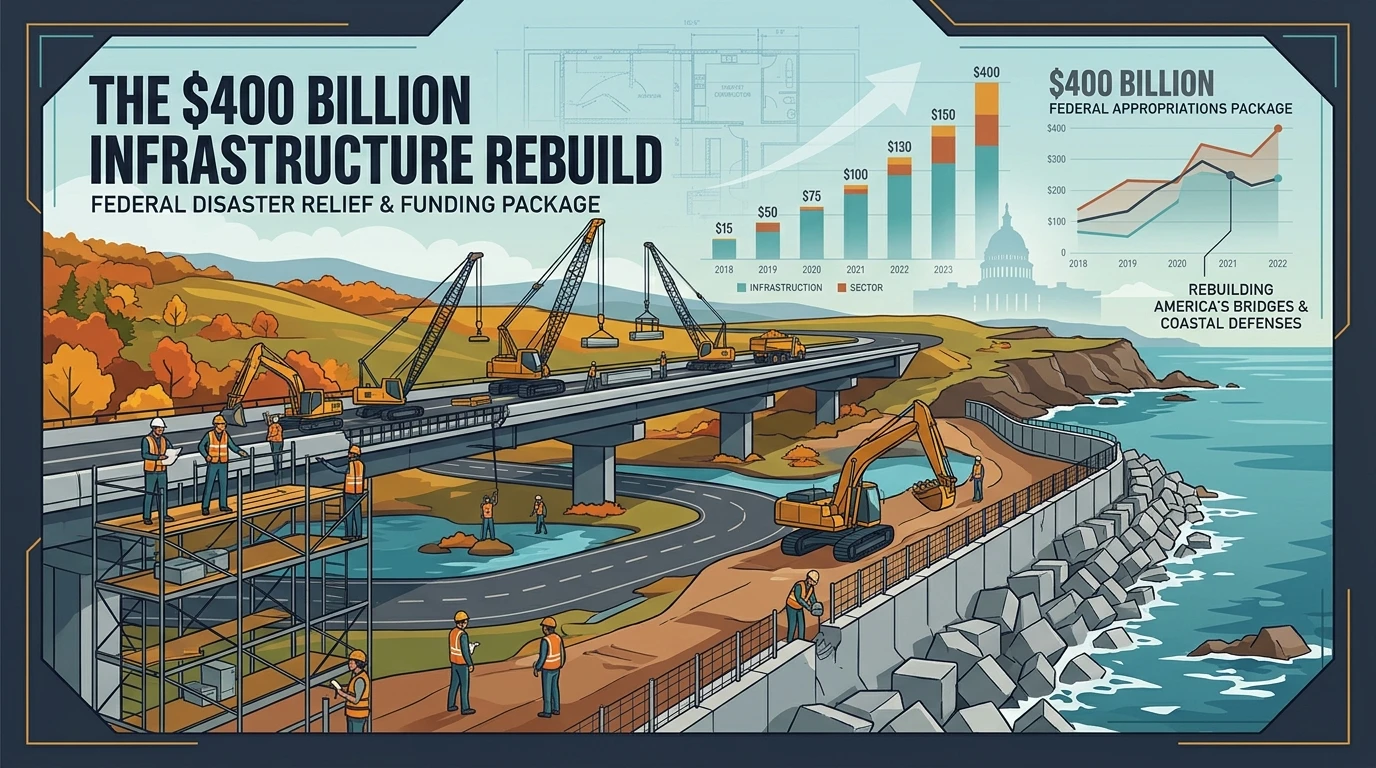
In a rare and urgent demonstration of cross-aisle cooperation following a turbulent election cycle, congressional leadership and White House budget negotiators reached an agreement in principle on Monday, November 9, on a historic $400 billion emergency disaster relief and critical infrastructure supplemental appropriations package. The legislation is slated for rapid floor action during the post-election lame-duck legislative session to address catastrophic infrastructure damages inflicted by record autumn hurricanes, historic inland flooding, and Western wildfires.
Replenishing Exhausted Emergency Response Reserves
The primary driver of the massive appropriations bill is the near-total exhaustion of the Federal Emergency Management Agency’s (FEMA) Disaster Relief Fund. Back-to-back major hurricanes that battered Florida, Georgia, and the Carolinas in September and October, combined with severe flooding across the Appalachian river valleys, depleted federal emergency response coffers to critical minimum balances, threatening ongoing debris removal and temporary shelter assistance for displaced residents.
The compromise legislation allocates $140 billion directly to FEMA’s disaster account, ensuring unhindered financial assistance for municipal rebuilding efforts, small business emergency loans, and direct homeowner recovery grants. Federal emergency officials praised the bipartisan accord, emphasizing that local communities cannot navigate multi-year reconstruction without guaranteed federal liquidity.
Long-Term Grid Hardening and Civil Engineering Investments
Going beyond traditional temporary disaster relief, the supplemental package dedicates more than $160 billion to hardening vulnerable civil infrastructure against future climate extremes. Funding streams administered through the U.S. Army Corps of Engineers and the Department of Transportation will underwrite modern coastal storm surge sea walls, elevated interstate highway overpasses, and dredged river containment channels across vulnerable metropolitan corridors.
Additionally, $60 billion is earmarked specifically for regional electrical utility grid resilience. Electrical utilities across hurricane-prone states will receive matching grants to bury vulnerable overhead transmission lines underground, install hardened concrete distribution poles, and deploy automated microgrid sub-stations equipped with battery storage to protect vital hospital facilities and emergency command centers during extreme weather outages.
Fiscal Accountability and Swift Lame-Duck Passage
To secure broad bipartisan support among conservative fiscal hawks and progressive appropriators, negotiators incorporated rigorous oversight provisions, including the appointment of an independent Special Inspector General for Disaster Infrastructure to conduct real-time audits of municipal procurement contracts and prevent fraud.
Leaders in both the House and Senate announced plans to bring the emergency legislation to the floor for formal roll-call votes early next week, bypassing standard committee markup procedures. With both parties recognizing the political and human necessity of delivering tangible relief to affected battleground communities, the measure is expected to pass with overwhelming majorities and arrive at the President’s desk for signature before Thanksgiving.
Editorial Fact Check & Key Findings
Key points
- Supplemental package authorizes $400 billion in emergency disaster funding.
- $140 billion allocated directly to replenish the depleted FEMA Disaster Relief Fund.
- Includes an independent Special Inspector General for Disaster Infrastructure.
What the evidence shows
White House and congressional negotiators agreed in principle on a $400 billion emergency supplemental bill allocating $140B to FEMA and $160B for long-term coastal and grid resilience.
Background and limits
Severe hurricane and flooding damages across the Southeast depleted federal emergency funds, requiring urgent lame-duck action.
Why this matters
Documented federal spending agreements dictate emergency recovery liquidity for state municipalities and infrastructure reconstruction.