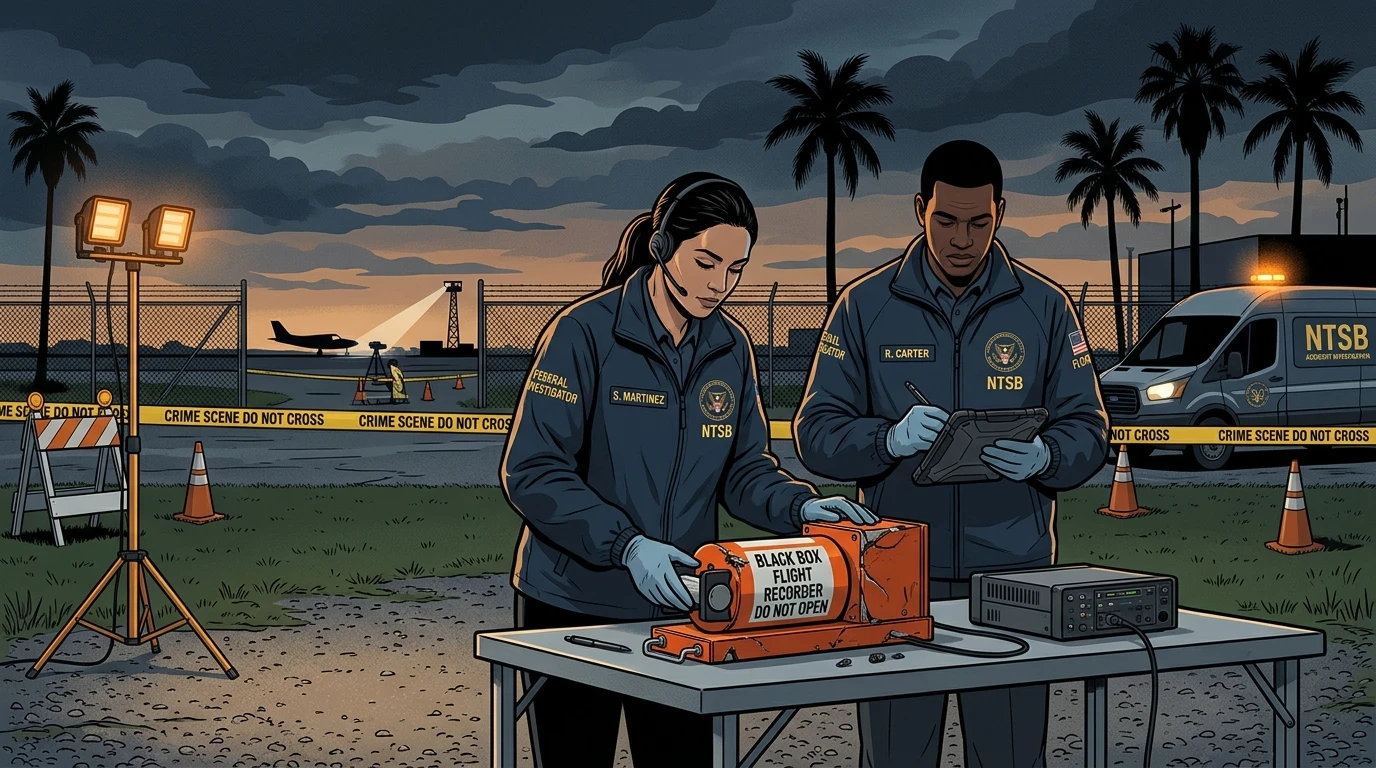
Federal aviation investigators from the National Transportation Safety Board (NTSB) and the Federal Aviation Administration (FAA) launched a comprehensive on-site investigation in Palm Beach County, Florida, on Sunday following the fatal crash of a twin-engine Learjet 60 business aircraft that killed all nine occupants aboard on Saturday afternoon.
Flight Path and Sequence of the Palm Beach County Incident
According to preliminary air traffic control recordings and radar telemetry, the aircraft departed from Texas en route to the Bahamas on Saturday afternoon. As the private jet approached South Florida airspace at approximately 3:45 p.m. local time, flight crews reported technical anomalies before radar contact was abruptly lost. The aircraft impacted an open recreational greenway in Greenacres, near West Palm Beach, narrowly missing surrounding residential housing developments.
Local emergency management personnel, county fire rescue units, and the Palm Beach County Sheriff’s Office responded immediately to the crash site, establishing a multi-block safety cordon and extinguishing residual ground fires. First responders confirmed that all seven passengers and two crew members aboard perished in the impact. Authorities confirmed that no ground fatalities or severe residential structural damage occurred in the adjacent community.
NTSB Deploys Go-Team to Secure Flight Recorders and Avionics
The NTSB dispatched an emergency Go-Team consisting of aviation specialists in airworthiness, powerplant engineering, air traffic communications, and survival factors. Speaking at an on-site media briefing Sunday morning, the NTSB lead investigator confirmed that federal personnel have successfully located the aircraft’s cockpit voice recorder (CVR) and digital flight data recorder (FDR). Both units will be transported under federal escort to the agency’s central technical laboratory in Washington, D.C., for extraction and spectral analysis.
Investigators spent Sunday documenting the wreckage debris field, examining flight control surfaces, engine turbine blades, and maintenance logbooks. Telemetry shows the aircraft descended rapidly from cruising altitude, prompting investigators to focus on possible structural separation, control system binding, or rapid decompression, alongside local meteorological conditions across the South Florida flight corridor at the time of the event.
Regulatory Review of Corporate Aviation Charters and Safety Directives
The tragic accident has refocused regulatory attention on private charter operating standards under FAA Part 135 certifications. Aviation safety advocacy organizations reiterated calls for accelerated implementation of modern flight data monitoring systems across mid-size private business aviation fleets, matching standards historically mandated for commercial airliners.
Federal authorities stated that a preliminary factual accident report will be published within 14 to 21 days, detailing verified radar tracks, pilot communications, and initial mechanical inspection findings. A full determination of probable cause, accompanied by potential safety recommendations for operators and maintenance organizations, will take between 12 and 18 months to complete.
Editorial Fact Check & Key Findings
Key points
- Learjet 60 crash in Palm Beach County resulted in nine fatalities.
- NTSB Go-Team successfully recovered both CVR and FDR flight recorders.
- Preliminary factual accident report expected within 14 to 21 days.
What the evidence shows
The NTSB and FAA launched an investigation in Greenacres, Florida, after a Learjet 60 crash claimed the lives of nine people on Saturday afternoon.
Background and limits
Federal investigators recovered both the cockpit voice recorder and flight data recorder for analysis at the NTSB laboratory in Washington, D.C.
Why this matters
Documented aviation investigative protocols determine mechanical, operational, and regulatory causes to prevent future fatal accidents.