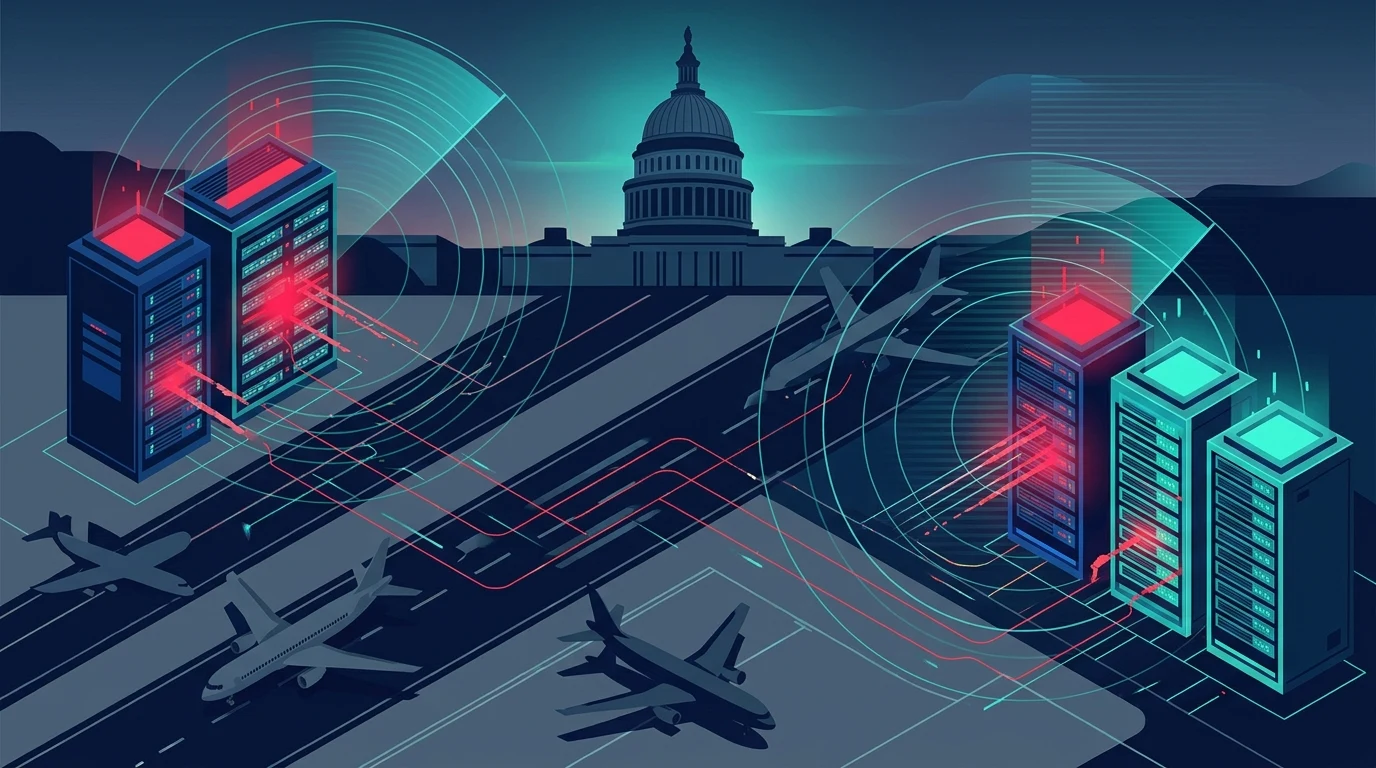
Mounting public fury over cascading digital infrastructure failures crystallized into formal government scrutiny on Monday, as leaders of both the Senate Commerce Committee and the House Homeland Security Committee announced joint, bipartisan investigations into the vulnerability, monopolistic concentration, and operational resilience of America’s critical cloud computing backbones.
The aggressive congressional inquiry follows unprecedented twin technological disruptions that paralyzed transportation and commerce over the preceding week. A massive configuration error within Microsoft’s core identity and cloud routing infrastructure knocked offline essential healthcare, financial, and government portals nationwide. Simultaneously, an unannounced telecommunications software patch triggered widespread system failures within the Federal Aviation Administration's (FAA) notice-to-air-missions and ground-stop systems, forcing the grounding of thousands of commercial flights and stranding tens of thousands of passengers.
The Peril of Single-Point-of-Failure Centralization
The core focus of lawmakers centers on the extreme market concentration of commercial cloud infrastructure and federal procurement mandates that have tied vital national security and civilian public utilities to a small handful of private tech conglomerates. Over the past decade, federal agencies and Fortune 500 enterprises have aggressively migrated legacy on-premise compute servers to centralized hyperscale cloud environments, theoretically to reduce operational costs and bolster cybersecurity.
However, as lawmakers pointed out during Monday’s joint press briefing at the Capitol, centralized cloud architectures create systemic single-points-of-failure where localized software bugs or configuration blunders can cascade into national economic paralysis within minutes.
"When a minor routine software update pushed by a private corporate contractor can simultaneously shut down commercial aviation, freeze banking transactions, and lock hospital emergency rooms out of digital patient records, we are no longer dealing with a routine IT glitch; we are confronting an active national security vulnerability," said the ranking member of the Senate Commerce Committee. "Congress must examine whether our federal agencies have become dangerously over-reliant on proprietary corporate monopolies without adequate redundancy or fail-safe operational alternatives."
Demanding Transparency, SLA Audits, and Backup Redundancy
The joint investigative letters sent Monday require executive leadership at Microsoft, commercial cloud service providers, and the FAA to provide exhaustive post-incident root-cause analyses, internal engineering communications, and all service-level agreement (SLA) enforcement records. Lawmakers are specifically scrutinizing why secondary backup failover clusters failed to engage autonomously during the disruptions, allowing service interruptions to persist for hours.
Industry analysts noted that the congressional push could catalyze landmark legislative changes in federal software procurement rules. Proposed reforms under discussion include statutory mandates requiring federal agencies to adopt multi-cloud hybrid architectures, mandatory air-gapped sovereign backup systems for life-critical transportation networks, and severe financial penalties for private contractors that experience systemic service interruptions.
With formal public hearings scheduled to begin next week, technology executives and federal regulators face intense pressure to deliver transparent explanations and implement verifiable safeguards, ensuring that America’s digital infrastructure can withstand inevitable software anomalies without grinding the nation to a halt.
Editorial Fact Check & Key Findings
Key points
- Bipartisan congressional committees opened joint investigations on Nov 23, 2026, into commercial cloud resilience.
- The probe follows cascading nationwide flight groundings by the FAA and widespread Microsoft cloud configuration blackouts.
- Lawmakers are scrutinizing single-point-of-failure vulnerabilities and mandatory failover redundancy standards for federal IT.
What the evidence shows
Congress initiated sweeping bipartisan probes on Nov 23, 2026, examining America's critical cloud infrastructure vulnerabilities. Following simultaneous FAA flight groundings and Microsoft enterprise outages, lawmakers demanded root-cause analyses from tech contractors and proposed multi-cloud mandates to eliminate single-point-of-failure risks.
Background and limits
Federal agencies and private corporations have rapidly centralized compute operations in a few mega-cap cloud providers over the past decade.
Why this matters
The investigation could lead to statutory mandates requiring redundant, multi-cloud architectures for life-critical transportation and healthcare networks.