
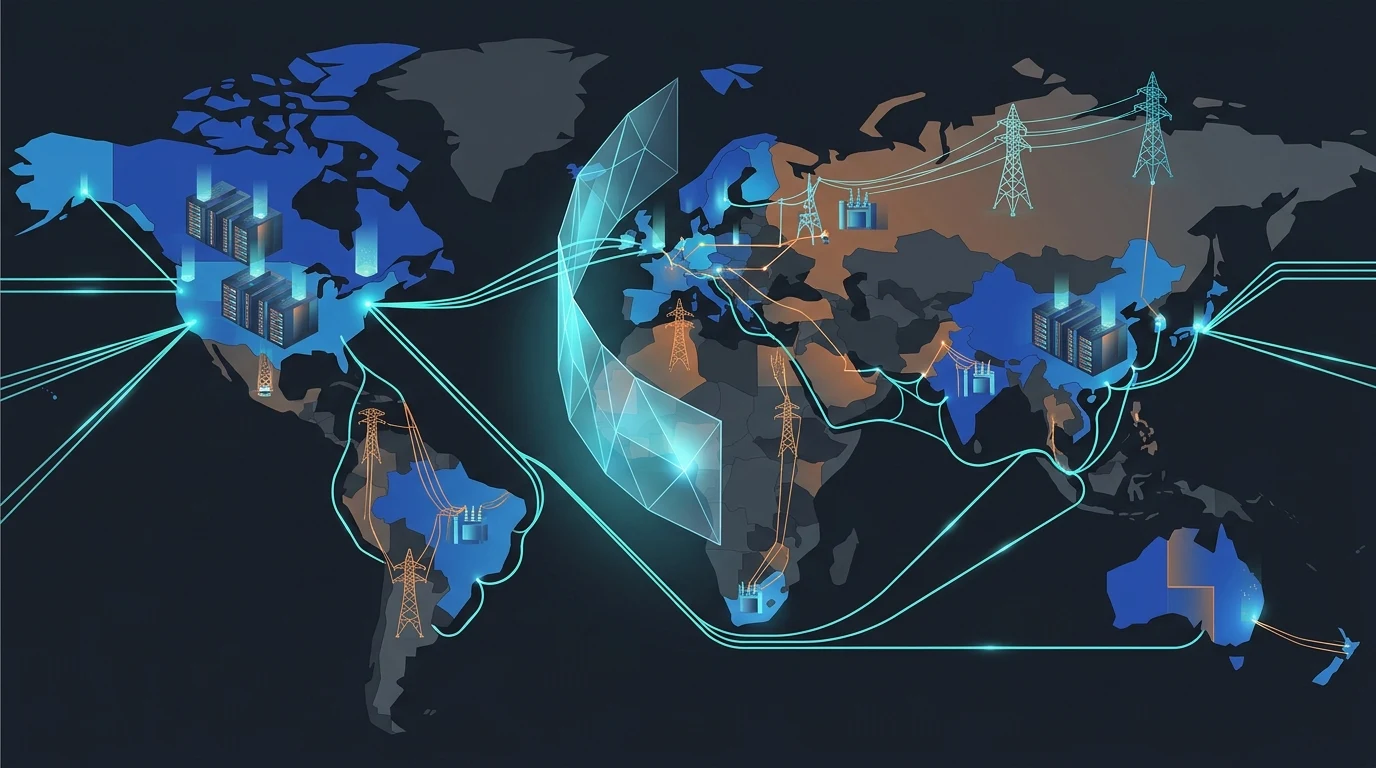
In a major escalation of its economic and technological nationalism agenda, the federal government on Friday unveiled a sweeping policy directive aimed at penalizing American technology conglomerates that construct hyperscale artificial intelligence data centers outside the borders of the United States. The measure seeks to curb a growing corporate practice wherein Silicon Valley cloud providers establish massive multi-gigawatt compute campuses in international jurisdictions to bypass lengthy domestic permitting timelines and local power grid bottlenecks.
The proposed framework, jointly drafted by the Department of Commerce, the Department of Energy, and the Office of the U.S. Trade Representative, outlines significant tax penalties, restrictions on the export of advanced dual-use semiconductor hardware, and potential tariffs on cross-border cloud compute imports. Officials stated that permitting domestic technology firms to offshore vital AI processing infrastructure jeopardizes national security and drains critical capital investment away from the American domestic industrial base.
The Battle Between Compute Demand and Grid Capacity
The regulatory initiative arrives at a moment of acute friction between technology enterprises and regional utilities across the United States. As frontier AI models require exponential increases in computational training power, hyperscalers have sought hundreds of megawatts per facility. In states like Virginia, Ohio, and Arizona, local municipalities and grid operators have begun pushing back against proposed facilities, citing surging household electricity rates, water consumption concerns, and strained distribution infrastructure.
To circumvent these domestic hurdles, several prominent tech titans have announced ambitious multi-billion-dollar investments in foreign territories boasting abundant geothermal, hydroelectric, or nuclear power, including Iceland, Norway, and the United Arab Emirates. Friday’s executive announcement directly targets these international agreements.
"American intellectual property and federal research funding laid the groundwork for the artificial intelligence revolution," a senior administration official stated during a background briefing. "We will not allow our leading technology corporations to export high-paying infrastructure jobs, advanced semiconductor clusters, and sovereign compute capabilities to foreign soil simply to evade domestic environmental and energy responsibilities. If companies want to benefit from American capital markets and federal contracts, their foundational compute must reside on American soil."
Silicon Valley and Industry Pushback
The tech industry's leading lobbying organizations reacted with immediate dismay to the proposed regulations, warning that penalizing geographic diversification will hobble American competitiveness against state-backed foreign competitors, particularly in China. Industry executives pointed out that building data centers overseas is frequently driven not by tax avoidance, but by the physical impossibility of securing interconnect agreements with regional American utilities within a reasonable commercial timeframe.
"Artificial intelligence operates as a global digital utility," stated a policy director at a major tech trade coalition. "Forcing American enterprises to wait six to eight years for domestic power grid connections while punishing them for building state-of-the-art facilities in partner nations will simply cede international cloud market share to foreign competitors who face no such jurisdictional restrictions."
Legal scholars anticipate substantial constitutional challenges regarding whether executive authorities can restrict foreign infrastructure investments under existing national emergency statutes. Nevertheless, the administration signaled that draft rulemaking will be formally submitted to the Federal Register within thirty days, setting the stage for a protracted legal and legislative confrontation over the future of global AI infrastructure.
Editorial Fact Check & Key Findings
Key points
- The White House announced a directive on Nov 20, 2026, targeting tech giants outsourcing AI data centers to foreign jurisdictions.
- Proposed penalties include tax surcharges, export restrictions on dual-use compute silicon, and tariffs on cross-border cloud compute imports.
- Tech firms had sought international locations to bypass lengthy domestic utility interconnection queues and local community pushback.
What the evidence shows
The federal government initiated a major policy intervention on Nov 20, 2026, designed to prevent American tech giants from building hyperscale AI data centers overseas. As domestic power constraints and ratepayer resistance delay projects in Virginia, Ohio, and Arizona, companies had explored facilities in Europe and the Middle East. The administration argues offshoring critical AI infrastructure threatens national security and domestic industrial vitality.
Background and limits
AI training clusters demand hundreds of megawatts, creating severe strain on regional electricity grids and generating contentious public utility commission disputes.
Why this matters
The policy sets up a major legal and economic confrontation between Silicon Valley's global infrastructure ambitions and Washington's technological nationalism.