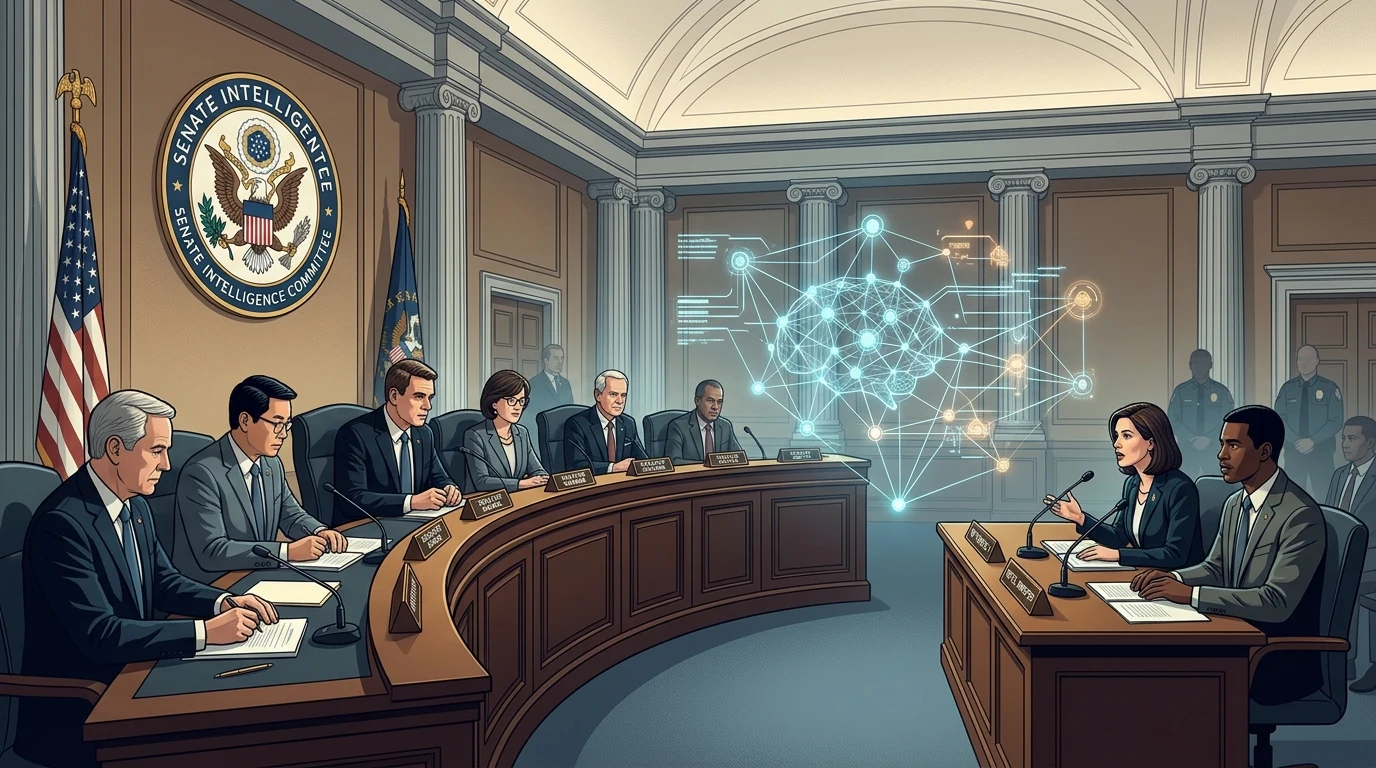
Escalating concerns over systemic fragility across the nation's digital backbone reached the upper echelons of Washington on Wednesday, November 18, as a bipartisan group of United States senators dispatched an urgent, high-level inquiry to the White House and Director of National Intelligence Jay Clayton. Citing consecutive technical disruptions that recently paralyzed federal aviation routing and degraded top-secret intelligence sharing, lawmakers warned that offensive artificial intelligence capabilities are evolving far faster than public and private defenders can deploy traditional software security patches.
A Mounting Threat of Algorithmic Vulnerability Exploitation
In a detailed formal memorandum addressed to the executive branch, members of the Senate Homeland Security and Intelligence Committees pointed to intelligence assessments indicating that foreign cyber adversaries and non-state ransomware syndicates are actively leveraging autonomous neural networks to automate zero-day vulnerability discovery. Rather than requiring human reverse-engineers weeks to decompile legacy software, generative AI models can analyze legacy federal codebases in seconds, identifying buffer overflows and logic flaws across critical infrastructure networks.
"The margin for error in securing sovereign American technical infrastructure has effectively evaporated," the senators wrote in their joint oversight correspondence. "Recent disruptions across our national airspace and defense communications proved that legacy systems are already straining under routine operational stress. When automated, adversarial artificial intelligence tools are deployed to probe those same fragile interfaces, the potential for catastrophic cascade failures across our electrical grids, financial transaction systems, and defense networks becomes an acute national emergency."
Demanding Real-Time Patching and Autonomous Defense Standards
The legislative inquiry demands immediate briefings from the National Cyber Director and the Cybersecurity and Infrastructure Security Agency (CISA) detailing how federal agencies plan to transition from reactive monthly security updates to real-time, autonomous cyber defenses. Lawmakers specifically pressed the administration on whether commercial cloud providers operating under federal security authorizations are equipped with AI-powered telemetry capable of intercepting synthetic cyber payloads before they penetrate perimeter routing gateways.
Capitol Hill staff confirmed that the inquiry also targets supply-chain verification for commercial off-the-shelf software utilized across civilian agencies. Lawmakers warned that software dependencies written decades ago must be systematically audited using automated code-scanning tools to eliminate exploitable legacy libraries.
Bipartisan Momentum for the Cyber Defense Modernization Act
Congressional leadership affirmed that the bipartisan inquiry lays the foundation for comprehensive emergency defense appropriations when the 120th Congress convenes in January. The proposed legislation would mandate federal adoption of post-quantum cryptographic standards, establish rigorous security compliance certifications for commercial AI models interacting with federal databases, and create an elite civilian cyber response corps to assist state and local utilities in fortifying municipal infrastructure against automated cyber incursions.
Editorial Fact Check & Key Findings
Key points
- Bipartisan senators pressed the White House and DNI Jay Clayton on AI-accelerated cyber threats.
- Highlighted that automated neural networks can decompile and exploit legacy federal code in seconds.
- Demanded federal adoption of real-time autonomous patching and post-quantum cryptographic standards.
What the evidence shows
A bipartisan group of U.S. senators sent an urgent inquiry to the White House and Director of National Intelligence Jay Clayton demanding strategies to defend critical infrastructure against accelerating AI-driven cyber threats.
Background and limits
Follows back-to-back technical disruptions that recently impacted federal aviation routing and intelligence sharing.
Why this matters
Official Senate Homeland Security and Intelligence Committee memorandum releases and DNI briefing notices confirm.