
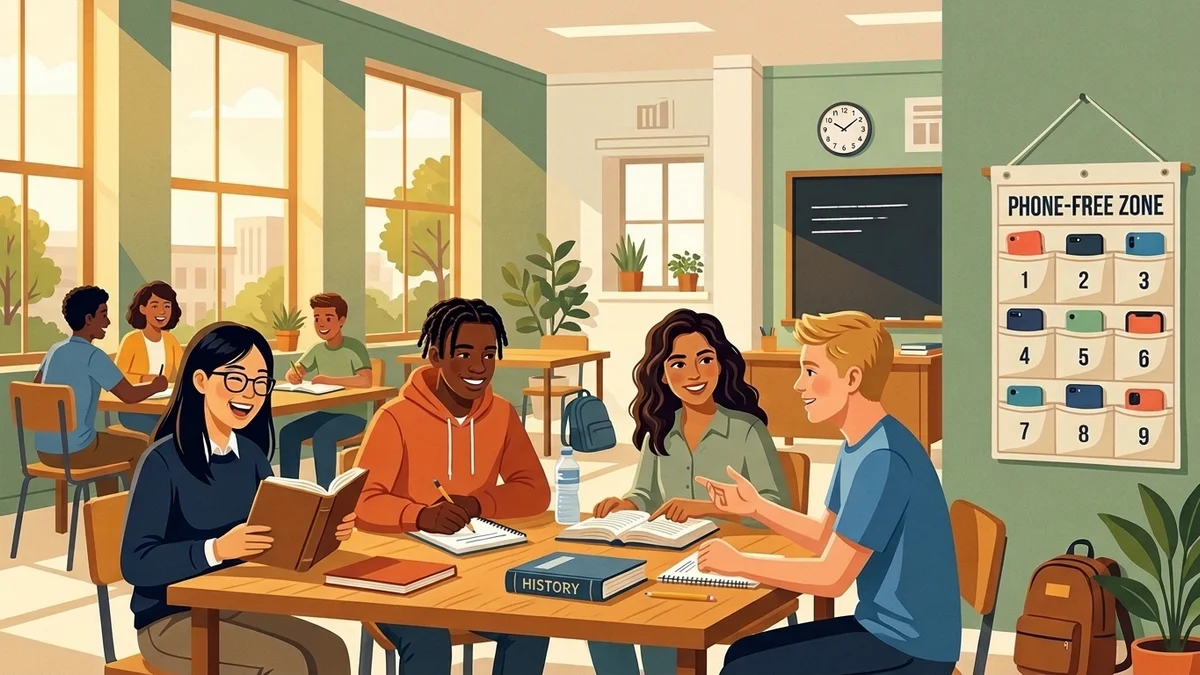
WASHINGTON — One of the fastest-growing education policy shifts in recent American history is paying measurable dividends, according to a landmark national survey published on Monday, revealing that public schools enforcing bell-to-bell cellphone bans have experienced dramatic improvements in academic focus, classroom socialization, and student mental well-being.
The comprehensive multi-state assessment, conducted by the National Association of Secondary School Principals (NASSP) in collaboration with university education research institutes, analyzed performance metrics and disciplinary data from over 850 public high schools and middle schools that instituted restrictive phone policies between 2023 and 2025.
Measurable Academic and Behavioral Improvements
The findings provide compelling empirical evidence validating the growing bipartisan movement among state legislatures and local school boards to remove personal digital devices from instructional spaces entirely:
- Disciplinary Referrals Down 38%: Incidents of in-class defiance, behavioral disruptions, and hallway conflicts declined by more than a third within the first full academic year of phone-free enforcement.
- Reduction in Cyberbullying: Principals reported a 46 percent drop in online harassment, unauthorized video recording in bathrooms, and social media drama during school hours.
- Test Score Uptick: Standardized mathematics and reading proficiency scores in adopting districts showed an average gain of 3.4 percentile points compared to demographically similar peer schools without restrictive policies.
- Increased Interpersonal Socialization: Educators noted an immediate resurgence in lunchroom conversations, hallway banter, and student participation in extracurricular clubs.
The Shift from Pocket Policies to Bell-to-Bell Bans
For over a decade, American schools experimented with permissive 'pocket policies' or classroom-by-classroom rules, allowing students to keep smartphones in backpacks or use them at teacher discretion. However, educators found that continuous notifications, social media algorithms, and group messaging created an insurmountable cognitive drain.
“When students walk into our building, they are no longer competing with multi-billion-dollar algorithmic distractions in their palms,” said Dr. Maria Elena Vance, a veteran high school principal in suburban Ohio. “The initial pushback from students and parents dissolved within weeks. Our classrooms are lively again, students look each other in the eye, and genuine deep learning has returned to our halls.”
Districts utilize a variety of enforcement methods, ranging from specialized magnetic lockable pouches (such as Yondr bags) to numbered hanging wall organizers and classroom storage lockers, ensuring that phones remain powered off and stored from morning arrival until afternoon dismissal.
Bipartisan Momentum Across State Capitols
The success of early-adopter districts has accelerated legislative action nationwide. Over a dozen states—including Florida, Indiana, Ohio, Virginia, and California—have enacted statewide statutory restrictions or executive directives requiring districts to limit student smartphone access during instructional hours.
While initial parental concerns centered on emergency communication, administrators have successfully reassured families by establishing streamlined front-office notification protocols. As national educational authorities evaluate long-term post-pandemic learning recovery, the removal of digital distractions is increasingly viewed as the single most cost-effective intervention to restore academic rigor and emotional resilience in American classrooms.