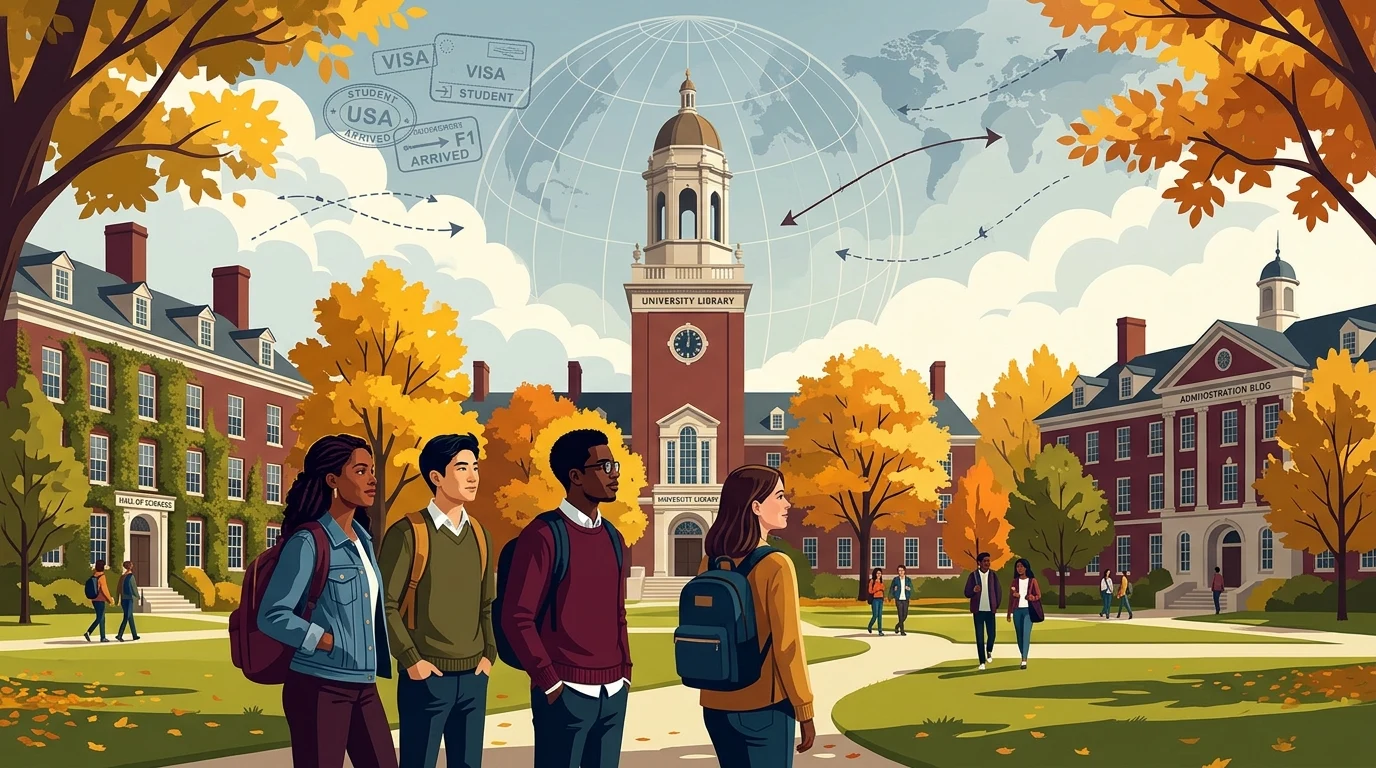
American higher education institutions are confronting an acute financial and institutional crisis following the release on Friday of comprehensive academic census findings revealing a sharp 9% year-over-year decline in total international student enrollments across U.S. colleges and universities for the current academic year. More alarmingly for admissions directors, the data showed a steep 15% collapse in first-time incoming undergraduate and graduate international scholars—marking the most severe single-year contraction outside of global pandemic lockdowns in modern academic history.
The benchmark data, compiled across more than 2,000 accredited degree-granting colleges and research institutions, underscores the compounding impact of intensified federal visa scrutiny, administrative processing delays, shifting geopolitical relationships, and aggressive recruitment competition from peer academic destinations including Canada, the United Kingdom, Australia, and European institutions offering English-language degree programs.
Severe Fiscal Ramifications for University Operating Budgets
The enrollment contraction poses an immediate threat to the operational stability of public and private universities already struggling with domestic demographic cliffs and state funding constraints. Unlike domestic undergraduates who frequently benefit from in-state tuition subsidies or need-based institutional financial aid, international scholars predominantly pay full out-of-state tuition rates, effectively subsidizing domestic academic programs, laboratory research infrastructure, and campus operational budgets.
"This is not merely an admissions statistic; it is a fiscal earthquake for American higher education," said a vice provost of enrollment management at a major Midwestern research university. "International student tuition revenue supports everything from graduate teaching assistantships to STEM research laboratories. Losing 15% of our incoming international cohort in a single cycle creates an immediate multi-million-dollar structural deficit that will inevitably force difficult decisions regarding program consolidation, hiring freezes, and course reductions."
State university systems across the Midwest, South, and Pacific Northwest reported the steepest declines, with regional institutions experiencing first-time international enrollment drops exceeding 20%. Graduate programs in computer science, mechanical engineering, and data analytics—which historically rely heavily on international graduate candidates—have reported significant unfilled laboratory cohorts.
Immigration Uncertainty and Global Competition
Higher education associations attributed the sharp downturn to an increasingly unpredictable immigration environment. Prospective scholars reported facing extended consular visa appointment backlogs, elevated visa denial rates, and widespread uncertainty regarding the future availability of Optional Practical Training (OPT) work authorizations following graduation.
Meanwhile, competitor nations have streamlined post-graduation work pathways and launched aggressive national branding campaigns targeting top academic talent across India, Southeast Asia, Latin America, and Sub-Saharan Africa. Education consultants in New Delhi and Seoul noted that prospective students and their families are increasingly opting for European and Asian institutions perceived as offering more predictable immigration frameworks and lower overall educational costs.
In response to the crisis, a bipartisan coalition of university presidents and business leaders issued a joint appeal to federal policymakers, urging the Departments of State and Homeland Security to modernize consular visa processing, establish expedited appointment tracks for accredited university matriculants, and affirm the nation’s enduring commitment to attracting global talent. Academic leaders warned that without prompt federal policy recalibration, American universities risk permanently forfeiting their preeminent standing as the premier global destination for higher learning, innovation, and scientific discovery.
Editorial Fact Check & Key Findings
Key points
- New census data released Nov 20, 2026, shows a 9% overall decline in international student enrollment across U.S. colleges.
- First-time incoming international student registrations plummeted by 15%, the sharpest drop outside pandemic lockdowns.
- Universities warn of multi-million-dollar budget deficits and cuts to graduate research programs that rely on out-of-state tuition.
What the evidence shows
American universities are facing severe financial strain after official census data on Nov 20, 2026, confirmed a 9% decline in total international students and a 15% drop in first-time enrollments. Tighter visa scrutiny, processing delays, and aggressive recruitment from universities in Canada, the UK, and Europe contributed to the sharp downturn.
Background and limits
International students pay full tuition, effectively subsidizing domestic academic programs, laboratory research, and operational costs.
Why this matters
The enrollment collapse threatens university budgets and risks eroding America's long-term competitive edge in global STEM talent and scientific innovation.