
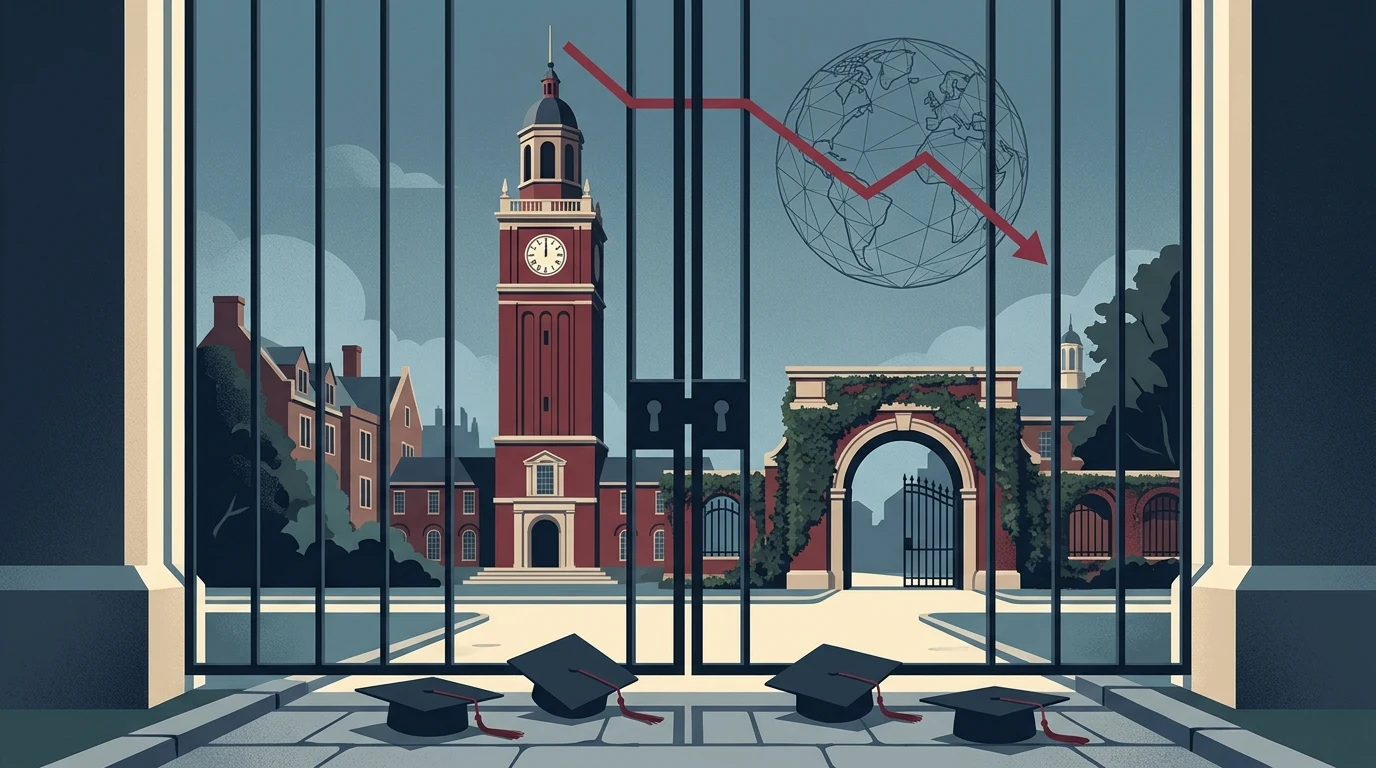
United States higher education institutions are confronting a steep contraction in global academic talent, according to sweeping national enrollment data released on Wednesday, November 11. Conducted jointly by NAFSA: Association of International Educators, Oxford University Press, and Studyportals, the Fall 2026 benchmark survey revealed that nearly 60% of surveyed American colleges and universities recorded sharp declines in new international graduate student enrollments—averaging a 13% year-over-year drop—while 45% reported shrinking international undergraduate cohorts.
Visa Bottlenecks and Geopolitical Headwinds
When university admissions deans and provosts were asked to identify the primary drivers behind the sudden enrollment downturn, nearly 90% pointed squarely toward tightening federal student visa adjudication policies, prolonged security screening backlogs, and heightened rhetoric surrounding immigration restrictions. Combined with escalating tuition rates and metropolitan housing inflation, prospective researchers in engineering, computer science, and biomedical sciences are increasingly diverting applications toward competing university hubs in the United Kingdom, Canada, Germany, and Australia.
"International graduate students are the lifeblood of American STEM research laboratories, engineering assistantships, and regional economic vitality," cautioned Fanta Aw, executive director of NAFSA, during the briefing. "When prolonged administrative visa holds deter top doctoral candidates from arriving in August, federal research grants stall and critical university teaching capacity evaporates."
Budgetary Ripples and K-12 Policy Shifts
The contraction poses acute financial risks for major public land-grant institutions and mid-sized private colleges that rely heavily on out-of-state and international tuition receipts to cross-subsidize domestic financial aid packages. In several Midwestern university towns, local chambers of commerce have already begun projecting softer winter apartment occupancy and reduced municipal sales tax yields linked to thinner campus populations.
Elsewhere in American education developments this week, federal and state policymakers focused heavily on domestic classroom accountability and curriculum standards. U.S. Secretary of Education Linda McMahon joined Cleveland Browns community officials in Ohio to honor 45 Intergenerational School students achieving drastic reductions in chronic absenteeism—an encouraging bright spot alongside early metrics from Cleveland's school restructuring showing rising middle-school enrollment in advanced algebra. Meanwhile, public university regents in Texas convened Wednesday to certify foundational curriculum compliance under Texas Senate Bill 37, strengthening board-level oversight over workforce readiness and degree costs.
Editorial Fact Check & Key Findings
Key points
- 60% of surveyed US universities reported an average 13% decline in new international grad students.
- 90% of respondents cited restrictive federal visa policies as primary enrollment deterrents.
- Education Secretary McMahon honored Cleveland students while Texas regents certified SB 37 curriculums.
What the evidence shows
A major joint survey by NAFSA, Oxford University Press, and Studyportals found 60% of US universities saw a 13% average drop in new international graduate students, alongside Cleveland attendance awards and Texas SB 37 reviews.
Background and limits
Roughly 90% of surveyed institutions attributed enrollment contractions to federal student visa processing hurdles and costs.
Why this matters
Verified NAFSA institutional enrollment surveys and state board filings establish higher education demographic shifts.