
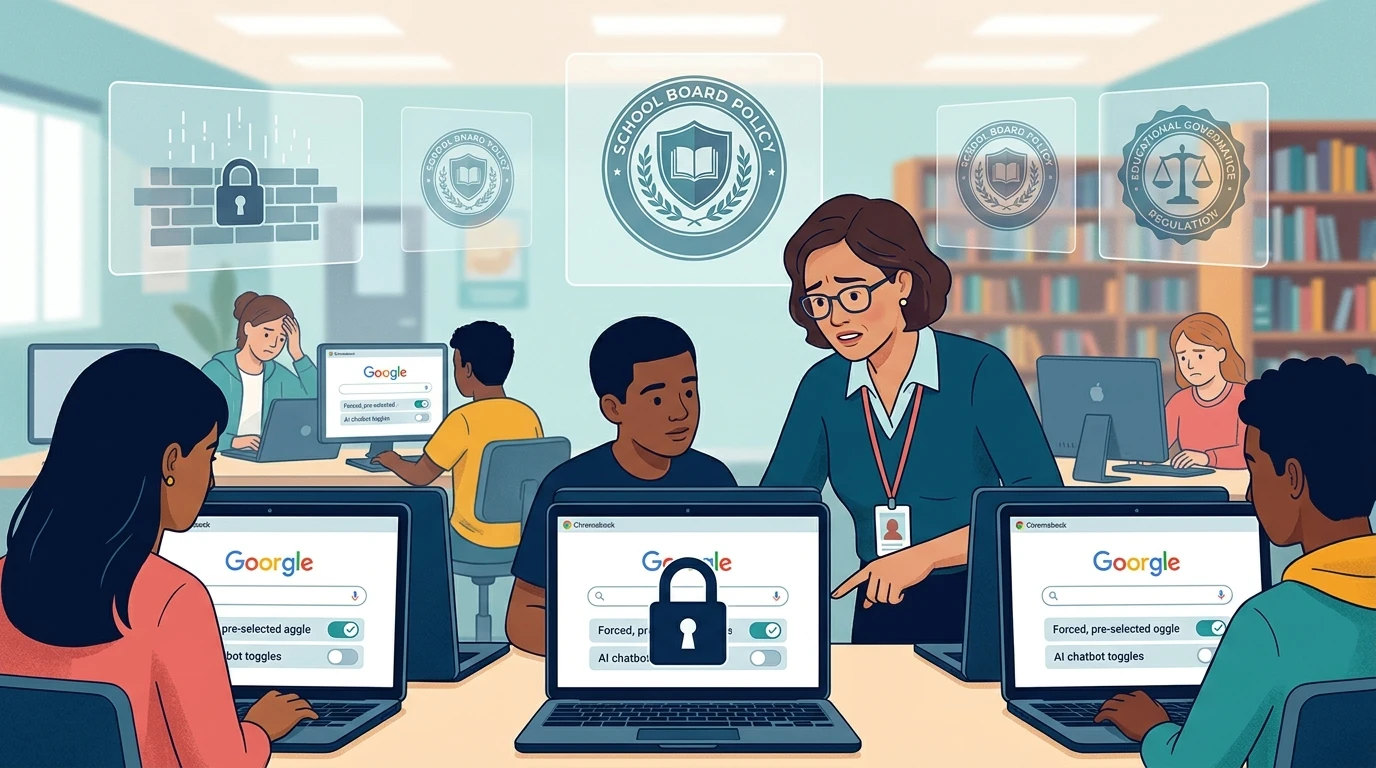
A contentious confrontation between Big Tech and public education erupted across the United States on Monday, November 9, as school district administrators, teachers' unions, and parental rights coalitions launched a coordinated national backlash against Google over a heavy-handed software licensing policy that shuts off access to basic Google Search for school districts that opt to disable generative artificial intelligence features on classroom devices.
The Controversial "All-or-Nothing" AI Integration Policy
The dispute centers on recent administrative updates to Google Workspace for Education, which powers digital learning infrastructure across more than 70% of American K-12 public classrooms. Under the revised terms, Google bundled its generative AI assistant, Gemini, directly into the foundational search and document ecosystem. School districts that sought to toggle off the AI chatbot—citing acute concerns over automated academic dishonesty, factual hallucinations, and student data privacy—discovered that doing so triggered an automated administrative lockout that disabled standard Google Search functionality on school-issued Chromebooks.
Superintendents and school board trustees across several major metropolitan districts slammed the coercive policy, accusing the technology giant of leveraging its monopoly dominance in search to force unvetted artificial intelligence tools into elementary and secondary classrooms without democratic local governance or parental consent.
Educator Concerns: Academic Integrity and Data Governance
Classroom educators and pedagogical researchers have voiced profound alarm regarding the forced integration of generative chatbots into daily student workflows. Teachers emphasize that having instantaneous AI summarization and essay generation embedded directly above standard search results undermines foundational skills of critical reading, source verification, and independent writing synthesis.
Furthermore, student privacy advocacy groups and state attorneys general raised urgent questions regarding student compliance with the Family Educational Rights and Privacy Act (FERPA) and the Children’s Online Privacy Protection Act (COPPA). School boards expressed concern that students’ conversational inputs, research prompts, and behavioral queries could be ingested into proprietary model training pipelines, creating permanent digital dossiers on minors without explicit parental authorization.
Legislative Scrutiny and the Push for Open Educational Alternatives
The controversy has quickly escalated to Capitol Hill and state legislative chambers. Lawmakers on both sides of the aisle condemned the search lockout policy, with members of the House Energy and Commerce Committee demanding an immediate federal investigation by the Federal Trade Commission (FTC) into potential anticompetitive tying practices under federal antitrust statutes.
Concurrently, several state departments of education, led by coalitions in California, Texas, and New York, announced emergency working groups to evaluate open-source, privacy-preserving search alternatives and independent educational operating systems. Educational technology leaders warned that unless Google provides granular, unbundled administrative controls that respect local curricular autonomy, school districts will accelerate plans to migrate their digital infrastructure away from corporate ecosystems toward independent public learning platforms.
Editorial Fact Check & Key Findings
Key points
- Google bundled Gemini AI into education workspace search tools.
- Disabling Gemini triggered administrative lockout of standard Google Search on Chromebooks.
- School districts in multiple states called for FTC antitrust and privacy investigations.
What the evidence shows
School boards and educators launched a national campaign against Google Workspace for Education for disabling standard Google Search on Chromebooks if administrators restrict Gemini AI tools.
Background and limits
Educators cited academic dishonesty and student data privacy under FERPA and COPPA as primary concerns.
Why this matters
Documented educational technology policies affect student data protections, curricular integrity, and local school district governance.