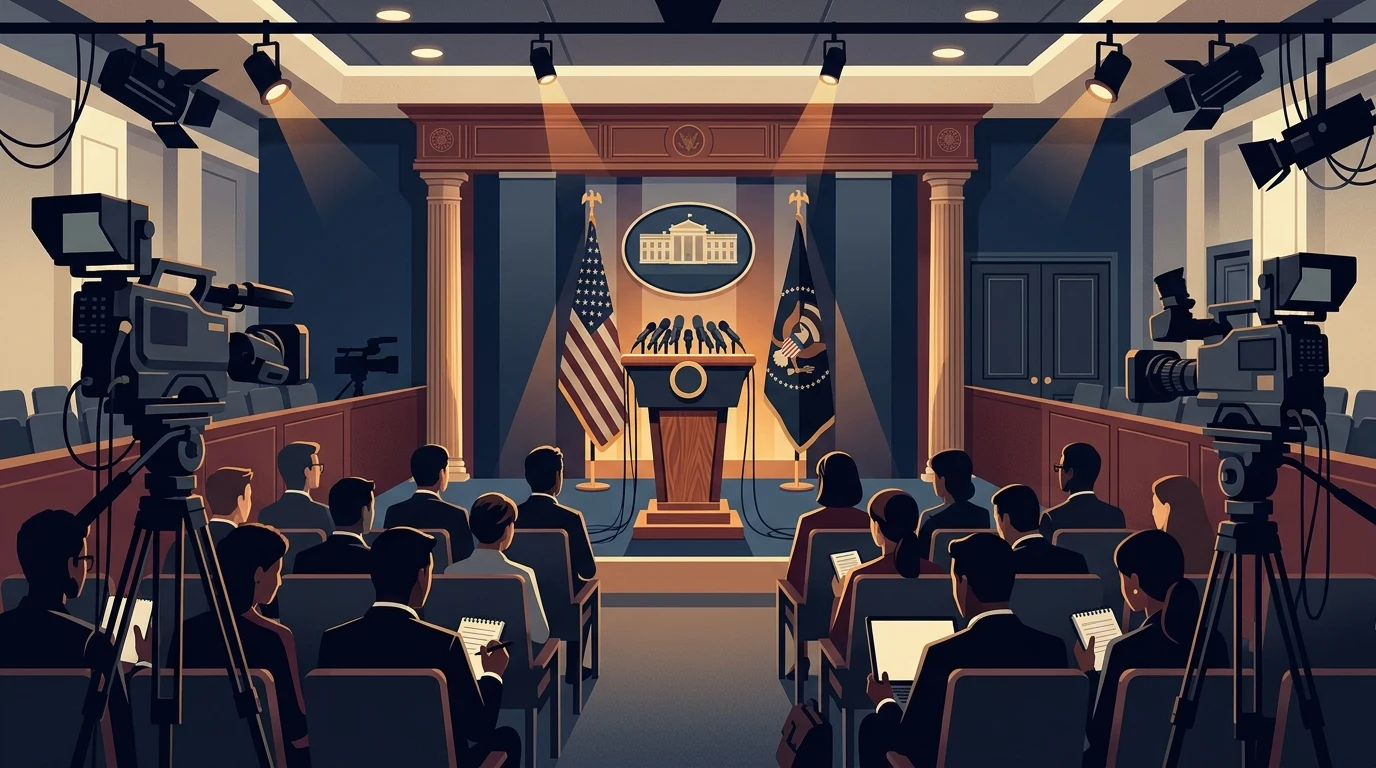
A packed session in the James S. Brady Press Briefing Room on Friday transformed an ordinary administration foreign policy update into a potent political spectacle, as President Donald Trump took to the lectern flanked by Vice President JD Vance and Secretary of State Marco Rubio. Ostensibly called to debrief the diplomatic press corps on the administration's recent multilateral discussions in Asia, the gathering swiftly pivoted into a substantive showcase of the administration’s most prominent internal factions and sparked widespread analysis regarding the contours of the 2028 Republican presidential succession.
For more than an hour, the president directed questions between himself, Vance, and Rubio, creating what veteran White House correspondents characterized as an informal audition platform for the two figures most frequently cited as prospective standard-bearers of the party’s populist and traditionalist wings. While the appearance projected institutional solidarity, political strategists noted that having the vice president and secretary of state share the briefing stage for major geopolitical rollouts remains an intentional and calculated maneuver to keep both figures visible before national audiences.
Skepticism on International Denuclearization
Substantively, the central foreign policy takeaway came when President Trump offered an unusually blunt assessment regarding the future of international arms control and the prospect of multilateral nuclear disarmament. Pressed on whether recent trilateral dialogues with Chinese and Russian leadership had established any actionable framework for reducing atomic stockpiles, Trump dismissed optimistic diplomatic expectations, stating that enduring geopolitical rivalry makes sweeping disarmament effectively implausible.
"Everybody talks about denuclearization, and in an ideal world, that would be wonderful," Trump stated from the podium. "We discussed it extensively with world leaders in Asia. But when you look at the reality of national defense, the reality of deterrence, and the mistrust between global superpowers, I am very skeptical that universal denuclearization can ever happen. Nobody is going to be the first to disarm, and the United States will ensure that our nuclear triad remains the strongest, most modern, and most capable force on earth."
The president’s remarks represent a notable recalibration from earlier diplomatic pronouncements that had teased grand disarmament summits. Arms control experts and nonproliferation analysts in Washington quickly reacted to the briefing, warning that publicly discarding denuclearization goals could formalize a tripartite nuclear arms competition between Washington, Beijing, and Moscow. Secretary Rubio followed up the president’s remarks by emphasizing that American strategy will prioritize strategic modernization and defensive deterrence pacts with Indo-Pacific partners rather than aspirational non-binding treaties.
The Emerging Dynamics of 2028
Beyond the national security implications, the visual staging of the briefing fueled intense commentary across Capitol Hill. Vice President Vance, who has built a dedicated coalition among populist conservatives and industrial labor constituencies, stepped up to address domestic economic repercussions of overseas trade negotiations, reinforcing his role as the administration's chief domestic messenger. In contrast, Rubio articulated the administration's strategic posture with polished diplomatic rigor, appealing to institutional conservatives and national security hawks.
Democratic leadership criticized the briefing as a taxpayer-funded campaign showcase masquerading as official statecraft. "What we witnessed today was an early primary debate held from the official podium of the American presidency," said one senior member of the Senate Foreign Relations Committee. "Rather than offering concrete solutions to rising global instability or strategic clarity on nuclear proliferation, the White House offered a political theater production."
As the administration prepares for a grueling legislative stretch ahead of the upcoming congressional session, the interplay between Vance, Rubio, and the executive office is poised to dictate not only executive governance but the long-term ideological trajectory of American conservative politics heading toward the next presidential cycle.
Editorial Fact Check & Key Findings
Key points
- President Trump held a joint White House press conference on Nov 20, 2026, alongside Vice President JD Vance and Secretary of State Marco Rubio.
- Trump publicly stated deep skepticism that universal denuclearization can ever happen due to superpower mistrust and deterrence necessities.
- The staging ignited intense political analysis regarding an early 2028 Republican presidential succession preview.
What the evidence shows
The Nov 20, 2026 White House press conference combined formal foreign policy debriefing with unmistakable political signaling. By fielding questions alongside Vice President JD Vance and Secretary of State Marco Rubio, President Trump elevated his administration's two most prominent potential successors. Substantively, Trump firmly stated that universal denuclearization is practically impossible given global rivalries, affirming that the U.S. will focus on strategic deterrence modernization.
Background and limits
The appearance followed the administration's recent multilateral discussions in Asia and comes amid growing discussions on Capitol Hill regarding foreign policy priorities and long-term party leadership.
Why this matters
The remarks formalize a shift away from aspirational nonproliferation treaties toward raw deterrence, while giving early shape to the ideological and political dynamics of the 2028 presidential cycle.