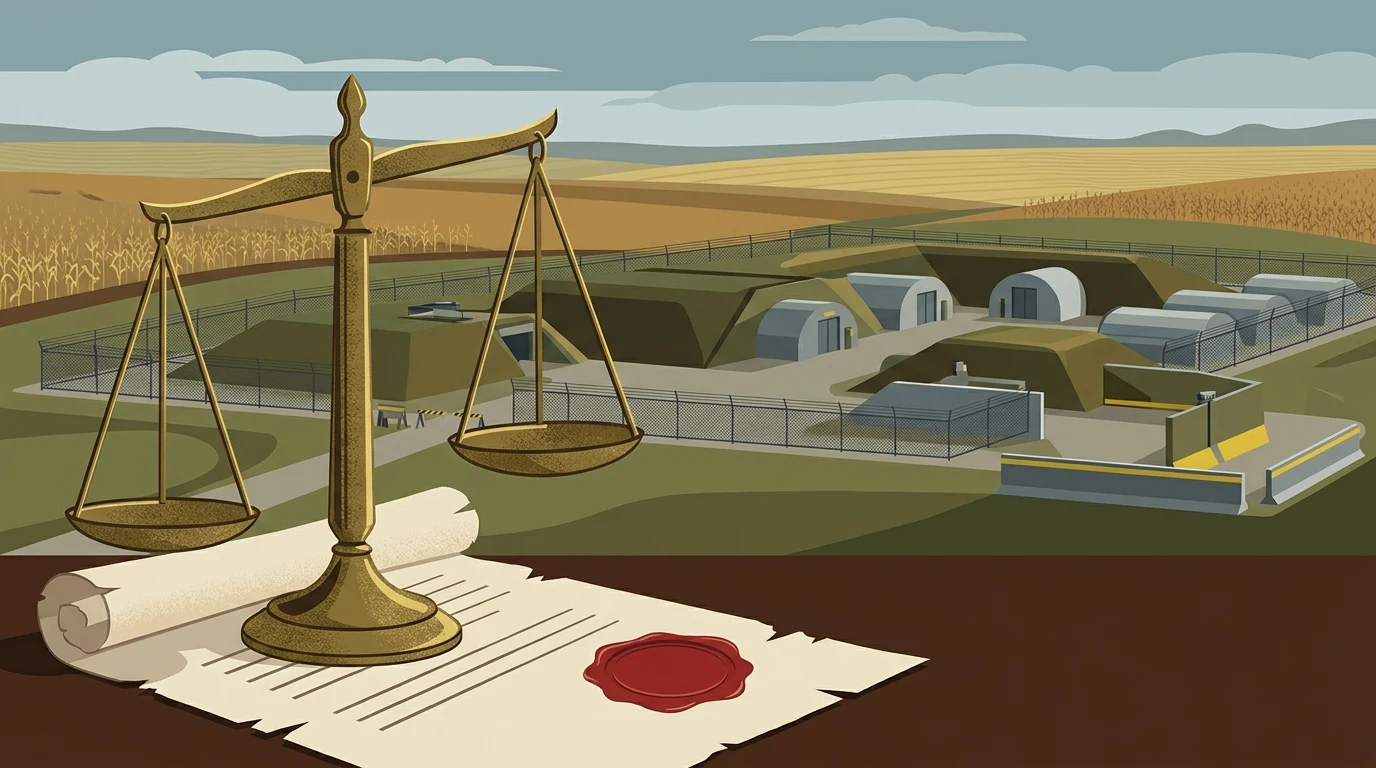
A high-stakes legal and environmental confrontation between the federal government and Midwest local communities escalated sharply on Sunday, as the U.S. Army formally notified a federal court of its intent to invoke statutory emergency provisions to proceed with the open-air detonation of tons of degraded bomb-making materials at the Iowa Army Ammunition Plant in Middletown, Iowa, effectively bypassing a temporary judicial injunction.
The legal clash centers on substantial stockpiles of aged lead azide—a primary explosive chemical utilized extensively in military detonators and artillery fuses. Government filings indicate that the chemical compounds, stored in bulk storage revetments across the 19,000-acre facility, have experienced severe chemical crystallization, rendering them acutely volatile and hypersensitive to thermal fluctuations, friction, and electrostatic discharge.
The Government’s Argument for Urgent Emergency Action
In filings submitted to the U.S. District Court for the Southern District of Iowa, Department of Justice attorneys representing the Army argued that the imminent onset of freezing winter temperatures presents an unacceptable, catastrophic risk to base personnel and the surrounding civilian population. Military ordnance experts asserted that ice formation and thermal contraction inside the compromised storage containers could trigger an uncontrolled chain reaction detonation.
"While the Army fully respects the role of judicial review, our paramount constitutional duty is the protection of human life and the safety of our workforce and surrounding communities," said an Army spokesman in a statement issued Sunday. "Ordnance disposal engineers have determined that these degraded materials have reached a critical threshold of instability that cannot safely await months of protracted litigation. Invoking federal emergency authority under environmental statutes is an extraordinary but necessary measure to neutralize an active, severe hazard."
Under the emergency disposal plan, specialized explosive ordnance disposal (EOD) teams would conduct controlled, open-air thermal burnings in specialized containment pits at the Middletown installation over the coming weeks, neutralizing the crystallized chemicals before winter storms set in.
Local Resistance and Environmental Backlash
The Army’s aggressive move sparked swift and vocal condemnation from local municipal leaders, agricultural associations, and environmental watchdog groups, including the Sierra Club and the Iowa Environmental Council. Opponents contend that open burning releases plumes of toxic lead particles, heavy metals, and hazardous air pollutants directly into the regional airshed, threatening public drinking water aquifers and contaminating adjacent livestock and organic grain farms.
Attorneys representing local residents filed emergency motions on Sunday requesting an immediate emergency hearing before the U.S. Court of Appeals for the Eighth Circuit, seeking a stay to enforce the lower court's injunction. They argued that contained, enclosed chemical destruction technologies—such as mobile hydrothermal oxidation systems—are available and could safely neutralize the compounds without open-air toxic emissions.
The dispute has placed a national spotlight on the environmental legacy of Cold War-era munitions facilities and the boundaries of executive authority. With federal appellate judges expected to issue an emergency ruling early Monday morning, the outcome will determine whether the military can proceed with immediate detonations or remain bound by court-ordered environmental safety reviews.
Editorial Fact Check & Key Findings
Key points
- The U.S. Army filed court notifications on Nov 22, 2026, intending to invoke emergency authority to detonate degraded lead azide in Iowa.
- A federal district judge had previously issued a temporary injunction halting open-air burns due to heavy-metal pollution concerns.
- The military argued that freezing winter temperatures could trigger uncontrolled accidental detonations of the volatile compounds.
What the evidence shows
The U.S. Army announced plans on Nov 22, 2026, to use statutory emergency provisions to override a judicial injunction and incinerate tons of crystallized bomb-making chemicals at the Iowa Army Ammunition Plant. While the military asserts cold weather poses imminent detonation risks, local agricultural communities and environmental groups requested emergency circuit court intervention to enforce safety reviews.
Background and limits
The 19,000-acre installation in Middletown stores substantial Cold War-era explosive stockpiles that have deteriorated over decades.
Why this matters
The conflict represents a major legal test regarding executive emergency authority under the Resource Conservation and Recovery Act (RCRA).