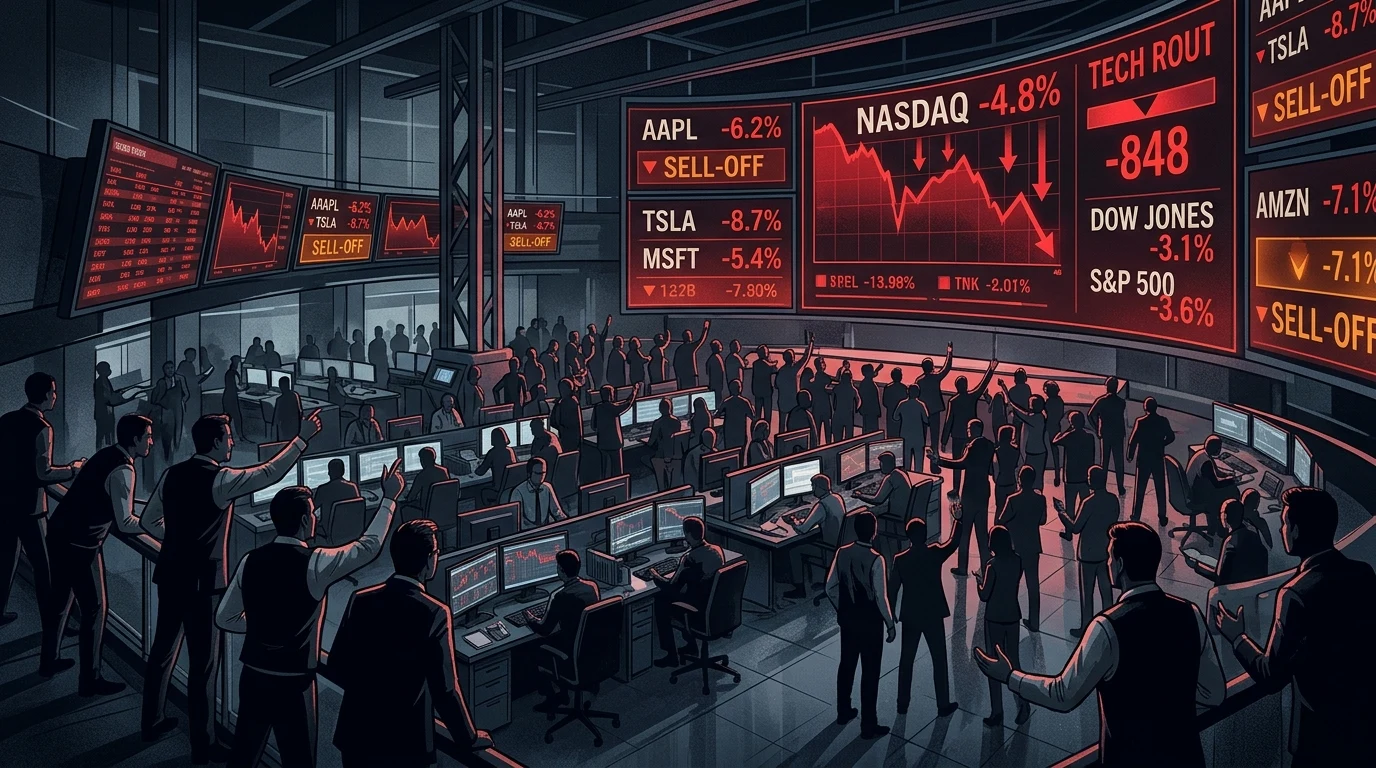
A relentless wave of institutional selling hit equity exchanges on Friday, culminating in Wall Street's worst weekly performance in more than 18 months. The benchmark S&P 500 tumbled 3.7% over the five-day trading period, wiping out months of hard-fought market gains and dragging the tech-heavy Nasdaq Composite into negative territory for the calendar year as investors aggressively reassessed the valuations of mega-cap artificial intelligence companies.
The broad-based market retreat was triggered by a confluence of rising macroeconomic anxieties, plateauing corporate earnings revisions, and a growing consensus among Wall Street asset managers that the monumental capital expenditure committed to AI infrastructure is yielding slower monetizable returns than previously forecasted. What began early in the week as measured profit-taking escalated by Friday afternoon into an across-the-board liquidation of semiconductor, cloud computing, and hyperscale data center equities.
The Semiconductor and Hardware Rout
At the center of Friday's market turmoil was the semiconductor sector, which had spearheaded the multi-trillion-dollar market expansion of the past two years. Leading chip manufacturers and hardware equipment suppliers experienced steep drawdowns, with major semiconductor indexes losing more than 6.2% on the week. Even companies delivering quarterly revenues that met consensus targets saw their shares punished as institutional guidance pointed to lengthening sales cycles and capacity digestion among tier-one enterprise clients.
"The market is transitioning from an era of unbridled optimism to an era of rigorous operational accountability," explained a senior portfolio manager at a New York investment fund. "For nearly two years, institutional allocators rewarded any executive team that pledged tens of billions to build out compute infrastructure. Now, portfolio committees are demanding tangible cash-flow returns, operating margin preservation, and clear commercial application revenues. When those numbers fail to meet astronomical valuation multiples, multiples compress violently."
The sell-off was exacerbated by shifting interest rate expectations in Treasury markets. Yields on benchmark 10-year U.S. Treasury notes held near cyclical highs, reflecting sticky core service inflation and diminishing expectations for aggressive Federal Reserve rate reductions in early 2027. Elevated debt financing costs have disproportionately impacted tech enterprises reliant on capital-intensive expansion plans and high-yield corporate bond issuances.
Broader Market Spillovers and Sector Rotation
While technology and consumer discretionary sectors bore the brunt of the downturn, selling pressure spilled across financial and industrial equities as risk-off sentiment took hold. Trading desks reported heavy volume in hedging instruments and volatility derivatives, with the Cboe Volatility Index (VIX) spiking to its highest intraday reading since early autumn.
In contrast to the tech drawdown, defensive market enclaves such as utilities, consumer staples, and healthcare witnessed modest institutional inflows, underscoring a pronounced defensive rotation. Investors sought haven assets in dividend-paying, cash-flow-resilient firms insulated from the capital expenditure volatility roiling Silicon Valley.
Market analysts warned that the correction could persist into the coming holiday weeks as tax-loss harvesting accelerates and hedge funds lock in annual performance fees. With key inflation gauges and central bank meetings scheduled for December, market participants are bracing for heightened volatility as Wall Street recalibrates to a more sober economic reality.
Editorial Fact Check & Key Findings
Key points
- The S&P 500 tumbled 3.7% in the week ending Nov 20, 2026, marking its worst five-day performance in over 18 months.
- The tech-heavy Nasdaq Composite dropped into negative territory for the calendar year as major semiconductor indices fell over 6.2%.
- Institutional investors pointed to plateauing earnings revisions and soaring infrastructure capex as catalysts for the valuation reset.
What the evidence shows
Wall Street experienced a significant tech-led market drawdown on Nov 20, 2026, driven by aggressive institutional profit-taking and multiple compression across artificial intelligence and semiconductor equities. High bond yields and growing scrutiny over corporate AI monetizability triggered a broad risk-off rotation into defensive market sectors.
Background and limits
Hyperscalers and technology enterprises have committed over $350 billion to compute infrastructure over two years, prompting portfolio managers to demand tangible cash flow returns.
Why this matters
This market correction represents a critical transition for tech valuations from speculative hype toward disciplined balance-sheet execution and revenue sustainability.