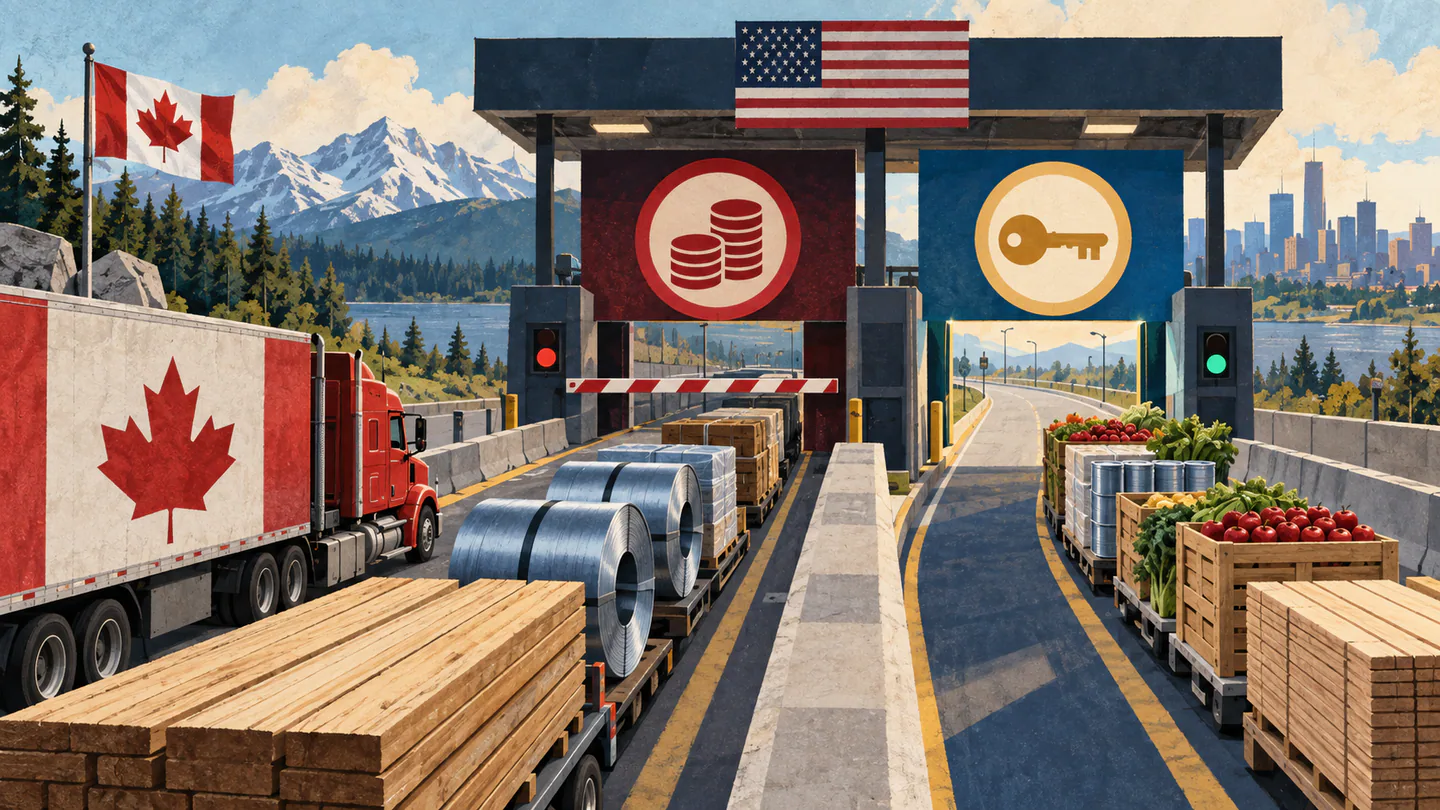
President Donald Trump announced a sweeping 50 percent tariff on a comprehensive range of Canadian imports, dramatically intensifying cross-border trade friction and triggering swift diplomatic pushback from Ottawa. The executive proclamation, unveiled during a White House press briefing, targets Canadian timber, energy exports, critical automotive components, and agricultural commodities, citing alleged trade imbalances and border compliance disagreements.
The punitive trade measure marks one of the sharpest ruptures in North American commercial relations since the renegotiation of the United States-Mexico-Canada Agreement (USMCA). In an official address, Canadian Prime Minister Mark Carney condemned the decision as an unwarranted unilateral action that directly violates established trade treaties, warning that retaliatory tariffs targeting American manufactured goods and agricultural products will take effect immediately.
Severe Supply Chain Disruptions Across the Automotive and Energy Sectors
The immediate fallout from the announced tariff hike was felt across North American financial and manufacturing hubs. Supply chain economists pointed out that modern manufacturing, particularly the automotive corridor connecting Michigan and southern Ontario, relies on high-frequency, tariff-free movement of components across the border. Imposing a 50 percent penalty threatens to halt production lines, idle assembly plants, and significantly elevate sticker prices for new consumer vehicles.
Energy analysts also warned that refineries in the American Midwest, heavily calibrated to process heavy crude delivered via Canadian pipelines, could see operational feedstock costs surge overnight. A sudden reduction in crude deliveries or retaliatory export surcharges could quickly translate into higher gasoline prices at American pumps ahead of key travel seasons.
Legal Challenges and Domestic Economic Pushback
The announcement drew immediate concern from business organizations on both sides of the border. The US Chamber of Commerce and multiple retail associations issued joint statements urging the administration to reconsider the tariffs, pointing out that import duties are ultimately paid by domestic businesses and American consumers through elevated retail prices.
Bipartisan coalitions of border-state lawmakers whose regional economies depend closely on open Canadian commerce have begun drafting legislative remedies and seeking judicial review. With trade attorneys preparing to challenge the emergency powers cited to impose the measures, the conflict looks set to test the institutional framework of North American economic integration for months to come.
Editorial Fact Check & Key Findings
Key points
- The July action covered specified goods.
- The additional duties were scheduled to begin in August.
- Canadian retaliation followed later.
What the evidence shows
President Trump invoked Section 338 of the Tariff Act of 1930 to order additional 50% duties on covered Canadian products. The measures focused on categories including alcohol, dairy and certain manufactured goods; they did not apply uniformly to every Canadian export.
Background and limits
Implementation was scheduled for August, leaving time for negotiations. Canada later announced retaliation after talks failed, so the announcement and the eventual tariff exchange should not be collapsed into a single event.
Why this matters
Scope and timing determine who pays. A tariff on listed products has a different economic effect from a blanket 50% charge on the roughly $382 billion in annual Canadian goods exports to the United States.