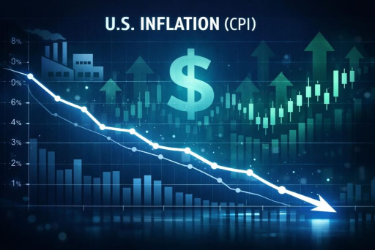
Financial markets are factoring in the probability that the Federal Reserve may lower interest rates in 2026 as 2025 comes to an end. Expectations that the central bank may switch from constraint to accommodation have increased due to softer inflation data, lessening market tension, and indications of sluggish growth. However, the way a number of economic factors interact will determine whether 2026 really sees a rate decrease, and not all of them are pointing in the same direction. It is difficult for investors to ignore the consensus. The fact that futures markets are pricing in lower short-term interest rates indicates that traders think the Fed will change course as the economy improves. This confidence is partly due to declining inflation: inflation expectations incorporated in financial instruments have slightly decreased, and headline Consumer Price Index (CPI) prints have slowed in comparison to previous surges. For the central bank to lower rates, softer price pressures are a necessary component. However, a decrease in inflation by itself does not always result in changes to policy. For a long time, the Fed has made it clear that its actions are based on data and are intended to achieve both maximum employment and stable prices. Although the term "soft CPI" may give traders hope, most indicators of inflation, especially core inflation, which accounts for housing and services and excludes volatile food and energy costs, still show inflation above the Fed's 2% objective. The Fed may postpone or restrict rate cuts if core inflation stays stubborn. Another level of complexity is introduced by the job market. Although employment growth has moderated from its recent explosive pace, it is still robust, and the unemployment rate is still at historically low levels. Although they haven't increased significantly, wage improvements have been strong enough to maintain consumer spending power in a comparatively constant range. Strong labor indicators can lessen the Fed's need to lower interest rates; policymakers want to avoid relaxing conditions too soon while inflation worries are still there. Policy credibility is another element that is frequently disregarded. The Fed might be hesitant to announce a rate-cut cycle too soon after years of battling inflation that escalated more quickly and hotter than many anticipated. Credibility of the central bank is important because it might undermine one of the economy's most vulnerable advantages if markets perceive early easing as a sign of weakness. Forward guidance has stressed prudence in recent years, emphasizing that rate choices depend on a persistent tightening of inflation rather than short-term declines. U.S. policy calculus is also influenced by global dynamics. The Fed's risk evaluations are influenced by foreign monetary circumstances, exchange rate swings, and geopolitical unpredictability. Import costs may rise in response to a declining currency, which is partially caused by rate expectations and can exacerbate inflationary trends. Coordinated assumptions about global rates are challenging because central banks in Europe and Asia are managing their own policy cycles. What does the markets' wager on cuts in 2026 actually represent? In many respects, it more accurately reflects a want for simpler circumstances than a technical prediction. For the stock and credit markets, investors desire more favorable financing conditions, reduced borrowing costs, and liquidity support. Despite more cautious policymaker rhetoric, futures markets are absorbing these preferences and converting them into implied rate paths. The forecast revolves around this conflict between market expectations and policymaker prudence. The Fed could be able to defend a rate-cut cycle if inflation data keeps cooling and the economy exhibits unmistakable signs of slowing growth without creating labor slack. However, the central bank may decide to keep rates unchanged well beyond 2026 if the inflation outlook stagnates or job data stays strong. History does serve as a reminder. Policymakers often start rate-cut cycles cautiously, cutting rates only in response to strong indications that inflation is under control and growth is in jeopardy. When expectations exceed economic fundamentals, markets that price aggressively or front-load easing run the danger of disappointing investors. This trend has been observed several times in previous cycles. In conclusion, rates may be lowered in 2026. It's not a sure thing, though. That result will be influenced by the convergence of inflation trends, labor market resiliency, international circumstances, and the Fed's dedication to credibility. Instead of assuming a decisive shift has already started, investors should prepare for a year of cautious policy debate as the new year progresses. Essentially, 2026 might end up being a year with rate cuts, but only if the data clearly supports it, not just because the markets want it to.